
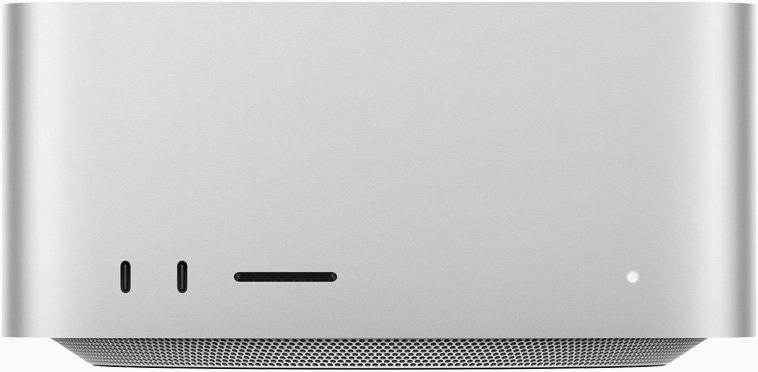
Your next AI bill might arrive as a computer purchase rather than a monthly cloud invoice. Apple’s M5 Ultra Mac Studio puts that possibility at the centre of a much bigger desktop-computing debate.
Apple’s newly introduced workstation supports configurations with up to 512GB of unified memory. The top M5 Ultra has a 36-core CPU and 80-core GPU, with 1.2TB per second of memory bandwidth. Those are maximum specifications, not the starting configuration: the base Ultra has 96GB of memory and fewer processing cores. Apple’s technical specifications set out the differences.
The appeal is straightforward. A machine with enough memory can hold substantial AI models locally, allowing some work to move away from rented servers. That does not establish that it will answer every question faster or more cheaply.
Why the memory matters more than the headline
An AI model needs space for its learned numerical parameters, plus working memory while it runs. A model that cannot fit comfortably creates a practical problem before raw processing speed even enters the conversation.
Apple’s MLX machine-learning framework uses shared memory accessible by the CPU and GPU, avoiding some copies between separate memory pools. That is a useful architectural distinction; it is not a promise that all 512GB is available to every model. The operating system, applications and the model’s working data still need room. MLX documentation explains the shared-memory approach.

The calculation behind a local AI machine
Consider a small team repeatedly processing internal documents. Local operation could be attractive if a suitable model can do the work, the computer is used heavily and the team can support it. The purchase price is spread across many tasks, while fewer requests need to be sent to an outside service.
A team using AI occasionally faces a different calculation. An expensive workstation sitting idle does not become economical simply because each additional prompt has no cloud token charge. Electricity, maintenance, software integration and staff time belong in the comparison too.
Local processing can also reduce the amount of information sent off-site, but privacy depends on the whole application. A desktop app may still contact remote services. Running a model locally and keeping an entire workflow offline are separate claims.
A challenger with a specific target
Apple presents the new Mac Studio as a platform for demanding creative work and on-device AI, including third-party model tools. Those are product capabilities and vendor positioning. Independent tests need to measure actual models, response speed, output quality and sustained operation before broad competitive claims are justified. Apple’s product overview provides its own demonstrations and comparisons.
This fits a wider shift already visible in AI agents running on Windows RTX PCs. More of the contest concerns where AI should run, not simply which company has the biggest remote model.
The M5 Ultra Mac Studio makes the desktop option more interesting. Its strongest argument will be a useful workload completed reliably at a sensible total cost. A large memory number opens the door; the software and the economics decide who walks through it.
Featured image: Apple Mac Studio desktop viewed from the front. Credit: Apple.
Leave a Reply