

Blood-forming stem cells are valuable gene-editing targets: change
the right long-lived marrow cell and its descendants could carry that
edit into multiple blood lineages for years. Reaching those cells safely
inside a living body is the difficult part.
A team led by researchers in China has now engineered lipid
nanoparticles that recognise CD34, a marker found on human
haematopoietic stem and progenitor cells (HSPCs). Loaded with CRISPR
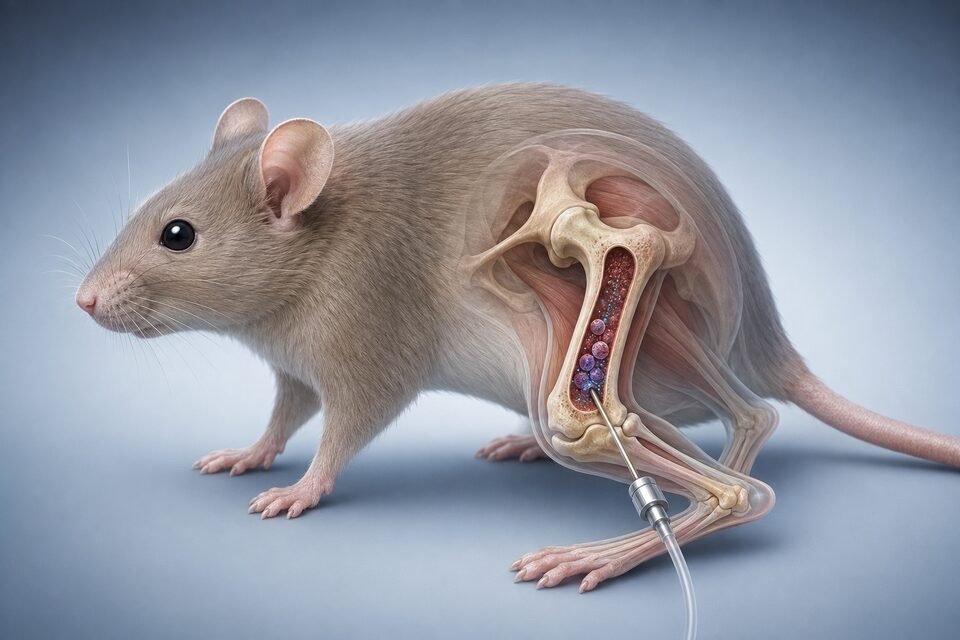
components and injected directly into the femur marrow of humanized
mice, the particles edited human HSPCs and produced effects that
persisted during long-term experiments.
The peer-reviewed study was
published in Nature Biomedical Engineering on 5 August
2026. It is an intriguing delivery advance, but the wording matters:
these were human cells inside mice. No person received
the nanoparticles, this was not a clinical trial, and the researchers
did not demonstrate a treatment ready for patients.
Why edit blood stem
cells inside the body?
Existing autologous stem-cell gene therapies generally require cells
to be collected, edited and tested in a specialist facility, then
infused after a conditioning regimen prepares the marrow. The approved
CRISPR therapy Casgevy follows this model. The FDA describes it as
an ex vivo, cell-based therapy, not an injection that edits marrow
in place.
An in-vivo system could eventually reduce collection and
manufacturing steps. However, this study did not show that direct
editing can replace conditioning, transplantation infrastructure or
today’s clinical safeguards.
How the CD34-targeted
nanoparticles work
The researchers screened 15 lipid-nanoparticle formulations for
carrying messenger RNA into human HSPCs. They selected LNP-DP and
attached an anti-CD34 antibody to its surface. The antibody acts as a
molecular address label for cells displaying CD34.
Inside is transient CRISPR cargo: messenger RNA encoding a Cas enzyme
and a guide RNA that directs it to chosen DNA. After uptake, the cell
temporarily makes the editing protein, which cuts the selected gene or
regulatory region.
The team used reporter mRNAs to track delivery, then tested CRISPR
cargo in cultured human HSPCs. The cells retained the ability to form
multiple blood-cell types in laboratory and transplantation assays.
CD34 is not unique to the rarest long-term stem cells; it also
appears on broader progenitor populations. Durability therefore required
more than a short-lived signal.
Direct marrow injection in humanized mice
The experiments used humanized mice: immunodeficient mice engrafted
with human blood-forming cells. They provide a living marrow environment
but not a complete human immune system or human-scale anatomy. A review of these
models describes gaps in lineage development and immune
function.
Delivery was highly local. Researchers injected the nanoparticles
into the distal femurs—directly into the thigh-bone marrow—rather than
using a conventional intravenous infusion. That leaves a major question:
can a practical route distribute an effective dose across the larger,
dispersed human marrow system?
The main BCL11A experiment used four mice and the ELANE experiment
three. Editing was also detected after recovered human cells were
transplanted into secondary mice, evidence that some modified cells had
durable repopulating capacity. It is proof of principle, not a
clinical-scale safety dataset.
Reactivating
fetal haemoglobin through BCL11A
The first disease-relevant target was an erythroid-specific enhancer
of BCL11A. After birth, BCL11A helps silence fetal
haemoglobin, or HbF. Disrupting the enhancer can lower BCL11A activity
in red-cell descendants and let HbF production resume.
This is relevant to sickle cell disease and beta-thalassaemia because
HbF can compensate for defective adult haemoglobin. Casgevy validates
the biological target, but edits patients’ cells ex vivo and is separate
from this platform.
After intrafemoral delivery, researchers found BCL11A-enhancer edits
across human blood-cell populations. Marrow-derived human erythroid
cells showed increased gamma-globin expression associated with HbF, with
evidence persisting through long-term observation and secondary
transplantation.
The experiment demonstrated sustained HbF reactivation in human
cells; it did not demonstrate reversal of sickle cell disease or
beta-thalassaemia in patients.
Partly restoring
neutrophil development
The second model involved ELANE, which encodes
neutrophil elastase. Dominant mutations can block neutrophil maturation
and cause severe congenital neutropenia, leaving patients vulnerable to
recurrent infections. GeneReviews
summarises ELANE-related neutropenia.
The mice carried human HSPCs with an ELANE mutation. CRISPR targeted
exon 2; disrupting this early section can make the cell eliminate the
faulty message through nonsense-mediated decay, reducing harmful mutant
protein.
After local nanoparticle delivery, the researchers reported robust
editing in human HSPCs and partial improvement in neutrophil development
during long-term observation. “Partial” is important: the study did not
show complete correction, normal infection resistance or a patient-ready
therapy.
Safety and delivery gaps before trials in people
Several hard problems remain before human testing could be
justified:
- A practical route must reach enough marrow throughout the body, not
only cells near an injected femur. - Sensitive tests must assess off-target edits, chromosome damage and
editing in true long-term stem cells. - Biodistribution studies must show where particles and RNA travel and
whether healthy progenitors are affected. - Immune responses to the antibody, lipids or bacterial Cas protein
could limit safety or repeat dosing. - Larger-animal studies must evaluate dose, inflammation,
manufacturing consistency and long-term cancer risk.
The study included biodistribution, inflammatory and
marrow-architecture checks, and the authors reported no broad disruption
of blood formation in their models. Those are valuable early signals,
but small mouse experiments cannot establish human safety.
What happens next
The platform’s key achievement is delivery: an RNA-carrying particle
reached human blood-forming cells in their marrow environment. Next,
researchers must test less invasive administration, larger animals and
longer follow-up.
For now, the narrow conclusion is the strongest one. CD34-targeted
lipid nanoparticles edited human HSPCs inside humanized mice,
reactivated fetal haemoglobin and partly improved an ELANE-related
neutrophil defect. That moves in-vivo blood-stem-cell editing forward,
but it remains preclinical research—not a human trial, an approved
treatment or evidence that patients can yet be edited with a bone-marrow
injection.
Reporting note
Nature Biomedical Engineering lists the study as accepted on
7 July 2026 and published on 5 August 2026. In this article, “in vivo”
refers to experiments conducted inside living humanized mice. It does
not mean the intervention was tested in people. Group sizes and
experimental-route details were checked against the paper’s figure
captions and supplementary information.
For a different approach to the delivery challenge, read about tiny CRISPR systems for gene editing inside the body.
Sources and further reading
- Primary
research paper in Nature Biomedical Engineering - PubMed record
and abstract - Supplementary
information for the primary paper - FDA prescribing
information for Casgevy - ELANE-Related
Neutropenia — GeneReviews - Earlier Cell
Stem Cell study of ELANE editing - Review
of humanized haematopoietic mouse models
FutureTechDose covers biotechnology, AI, data-centre and
energy-sector research and industry progress for a general audience.
This article is informational and does not provide medical or investment
advice.
Leave a Reply