
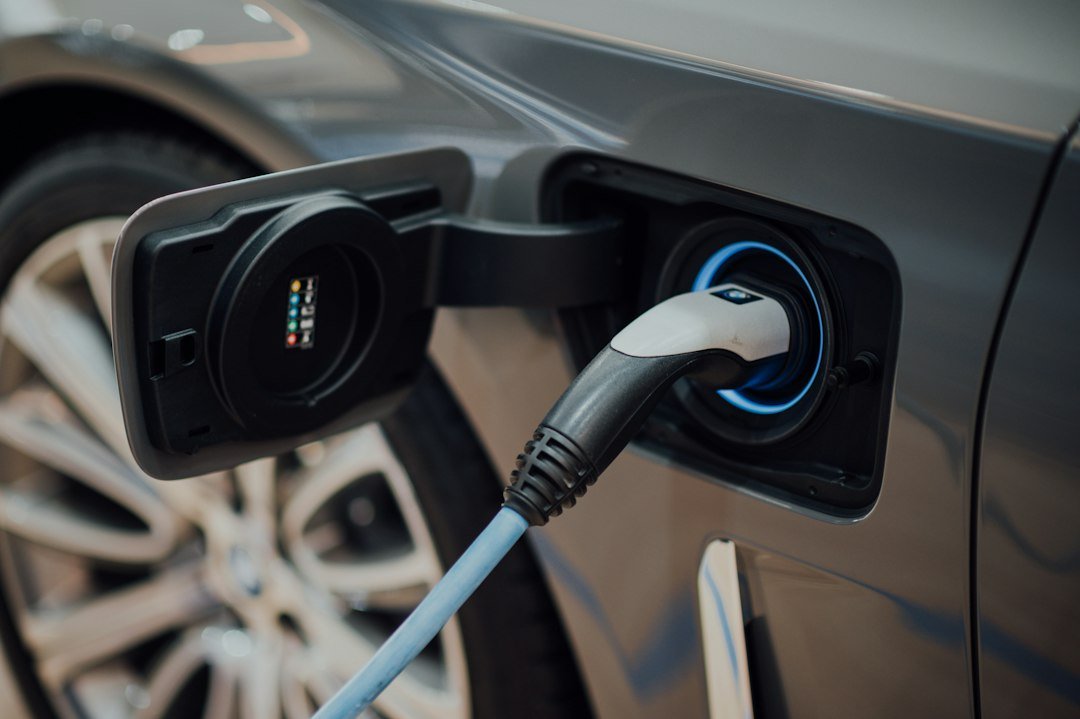
Featured image: An electric-vehicle charging connection illustrates one possible application of fast charging. Contextual photograph; the vehicle does not use a verified GMG battery. Photo: CHUTTERSNAP / Unsplash. Unsplash licence.
Fast charging is only useful if a battery also stores enough energy and survives repeated use. A new prototype update addresses that combination, while leaving an important engineering gap between a tested cell and a finished system.
On 8 October 2026, Graphene Manufacturing Group reported improved performance in its 1.5 ampere-hour G CELLS. The Battery Innovation Center in Indiana built and tested the cells using GMG materials. The release describes prototype results, not a commercial electric-vehicle battery or an independently peer-reviewed pack study. Read the developer’s test update.
Separate tests tell different parts of the story
GMG reports 1,000 cycles without performance reduction at a stated 7C rate. A separate cell tested at 10C retained about 90% of capacity after 393 cycles. The release also reports 58 watt-hours per kilogram at 10C, up from 39 Wh/kg, and 94% energy efficiency.
Those conditions should stay attached to the numbers. The 1,000-cycle result and the 10C result are not one identical test. The release’s lithium-titanate comparison concerns the particular benchmark cell tested, rather than establishing superiority over every product using that chemistry. Cycling conditions and comparison data.
A useful result can lose its meaning when a headline combines the best figure from each experiment into an imaginary all-purpose battery. Here, the evidence is more specific: encouraging performance under several stated laboratory cycling conditions.

Charge capacity, energy and speed are different measurements
An ampere-hour measures electrical charge. Watt-hours measure energy, and watt-hours per kilogram describe energy stored for a given mass. C-rate expresses current relative to rated charge capacity: 1C corresponds nominally to moving that charge over one hour, while 10C corresponds to six minutes. Actual usable capacity and charging protocols matter. DOE background on capacity and C-rate.
That is why a six-minute claim needs a defined starting and finishing state of charge, voltage limits and temperature. A nominal rate is not automatically proof that a complete vehicle pack can be filled from empty to full in six minutes.
Batteries store electricity through chemical changes, with ions moving inside the cell and electrons moving through the external circuit. The US Department of Energy explains that repeated cycling does not perfectly reverse every process; structural and chemical changes can gradually reduce performance. DOE explanation of rechargeable batteries.
A bigger cell introduces a bigger set of constraints
A commercial system must combine many cells with electrical connections, protection and control. A system-level test therefore needs to report usable energy, efficiency and durability after those additional parts are included. Cell-level energy density should not be silently relabelled as pack-level energy density.
The Department of Energy’s development framework separates materials research, applied cell research, and development of robust cells and modules for particular applications. It treats cost, weight, volume, power, energy, durability and tolerance of abuse as simultaneous requirements. One strong result does not settle that whole list. DOE battery-development framework.
For this programme, useful next disclosures would include repeat tests across multiple production batches, the number of cells tested, temperature histories and results in larger formats. These would help distinguish a reproducible manufacturing outcome from the behaviour of selected prototypes.
The application decides which trade-offs matter
A lightweight long-range vehicle, a device that receives frequent short bursts of power, and a stationary installation do not place identical demands on a battery. Charging speed may be valuable in all three, but the acceptable balance of mass, volume, lifetime and cost differs.
An informative demonstration would specify that intended job and test the full system against it. It would also make clear how charging equipment, thermal control and operating limits affect the advertised speed. Those are questions for engineering validation, not conclusions supplied by a material’s name.
The prototype update is worth following because it reports progress across several measurements. The decisive next step is to preserve that performance as cells become larger, manufacturing becomes repeatable and the battery is asked to do a defined real-world job.
Leave a Reply