
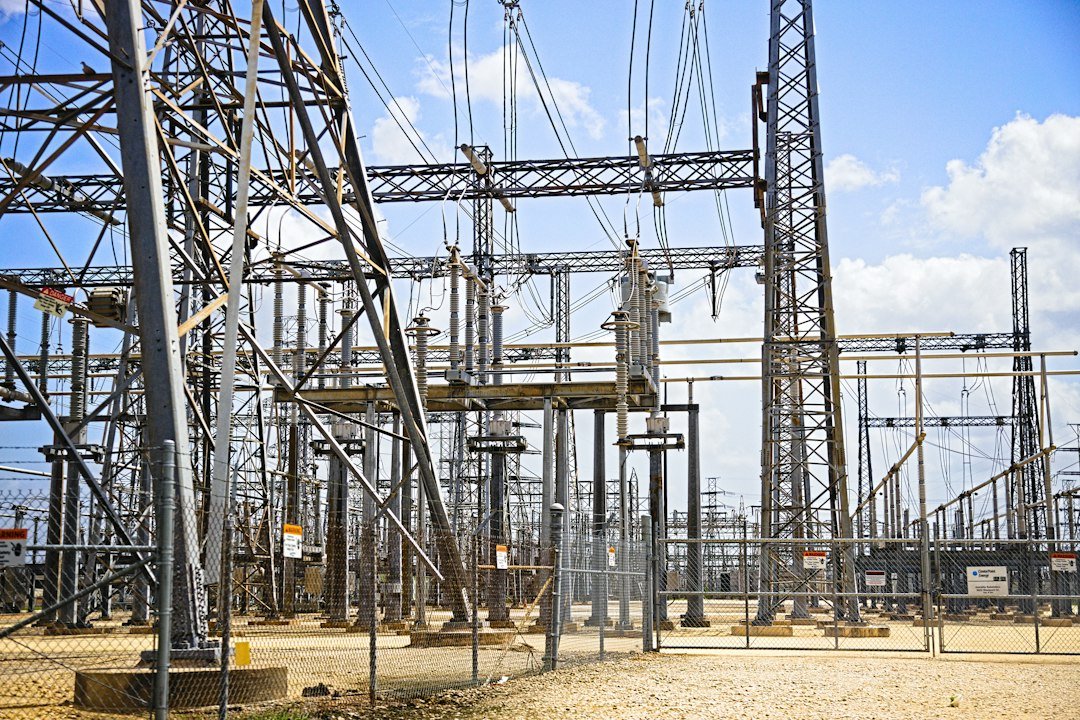
Featured image: A high-voltage substation illustrates grid infrastructure. Contextual photograph; not the Huntly site, its battery or visual evidence of its operating performance. Photo: Sam LaRussa / Unsplash. Unsplash licence.
A power project changes category when it begins operating. Genesis Energy has officially opened a 100-megawatt, 200-megawatt-hour battery energy storage system at the Huntly power-station site on New Zealand’s North Island, according to a 20 October 2026 report from pv magazine Australia. The battery is described as live.
That makes this a commercial commissioning story, not a proposal or laboratory demonstration. It also demands a second distinction: another 100 MW/200 MWh stage has reached a final investment decision, but that planned capacity is not yet online.
Power and energy describe different jobs
The battery’s 100 MW figure is its power rating—the maximum rate at which it can charge or discharge under the specified design. The 200 MWh figure is an energy quantity. Dividing 200 MWh by 100 MW gives a nominal two hours at full rated power.
That arithmetic is a useful reference, not a promise that every dispatch will follow a perfect two-hour rectangle. Operators may hold back capacity for reserves, respond at partial output, protect the battery’s state of charge or combine several services. Usable energy can also differ from the nameplate figure under operating limits.
The system stores electricity; it does not create it. Charging draws energy from the grid or Genesis portfolio, and later discharging returns less than was taken because every storage cycle has losses. Its value comes from timing and speed rather than net generation.
A fast response can complement slower assets
The Huntly site also contains coal- and gas-fired generation. Genesis says the battery can start almost immediately, allowing it to respond faster when the system needs extra power. Fast response can help balance short changes in supply and demand, smooth fluctuations and provide grid services.
Those functions should not be translated into a claim that the battery replaces every role of the existing power station. A two-hour store and a fuelled generator have different energy limits, start-up characteristics, emissions and operating economics. The grid can value both power delivered in seconds and energy sustained over many hours.
Huntly’s existing transmission connection is also relevant. Placing storage beside a major generating site can use established grid infrastructure and operational expertise, though the actual connection and dispatch arrangements still determine what the asset can provide.
The first stage has crossed the delivery line
Genesis began construction on the first stage in 2025 with a budget of less than NZ$150 million. The October report says the project was delivered in about 14 months for roughly NZ$130 million and uses 70 Saft battery units installed by Northpower.
Those figures describe a completed project reported by the developer and trade press. The next evidence is operational: availability, degradation, actual response to grid events and revenue across services. Commissioning proves that the system can enter service; it does not yet supply a multi-year performance record.
Stage two is a decision, not another live battery
Genesis has separately announced a final investment decision for a second 100 MW/200 MWh system. The corresponding NZX announcement gives an estimated NZ$106 million cost and targets full operation in the third quarter of the company’s 2028 financial year.
A final investment decision is substantial: it usually means the sponsor has approved capital and intends to proceed under the stated plan. It is still followed by procurement, construction, testing and connection work. Reporting the two stages as a 200 MW/400 MWh operating battery today would collapse those stages and double the live capacity on paper.
Genesis presents Huntly as a multi-stage storage site that could eventually reach 400 MW/800 MWh. That is a longer-term development envelope, not commissioned capacity. Each stage must be funded, built and tested.
The important news is already strong without borrowing from the future. New Zealand now has another fast, two-hour grid asset operating at a strategically connected site. Its real contribution will become clearer in dispatch and reliability data, while the second stage begins the harder journey from investment decision to electrons delivered.
Reporting and source checks completed on 21 October 2026. By FutureTechDose Editor.
Leave a Reply