
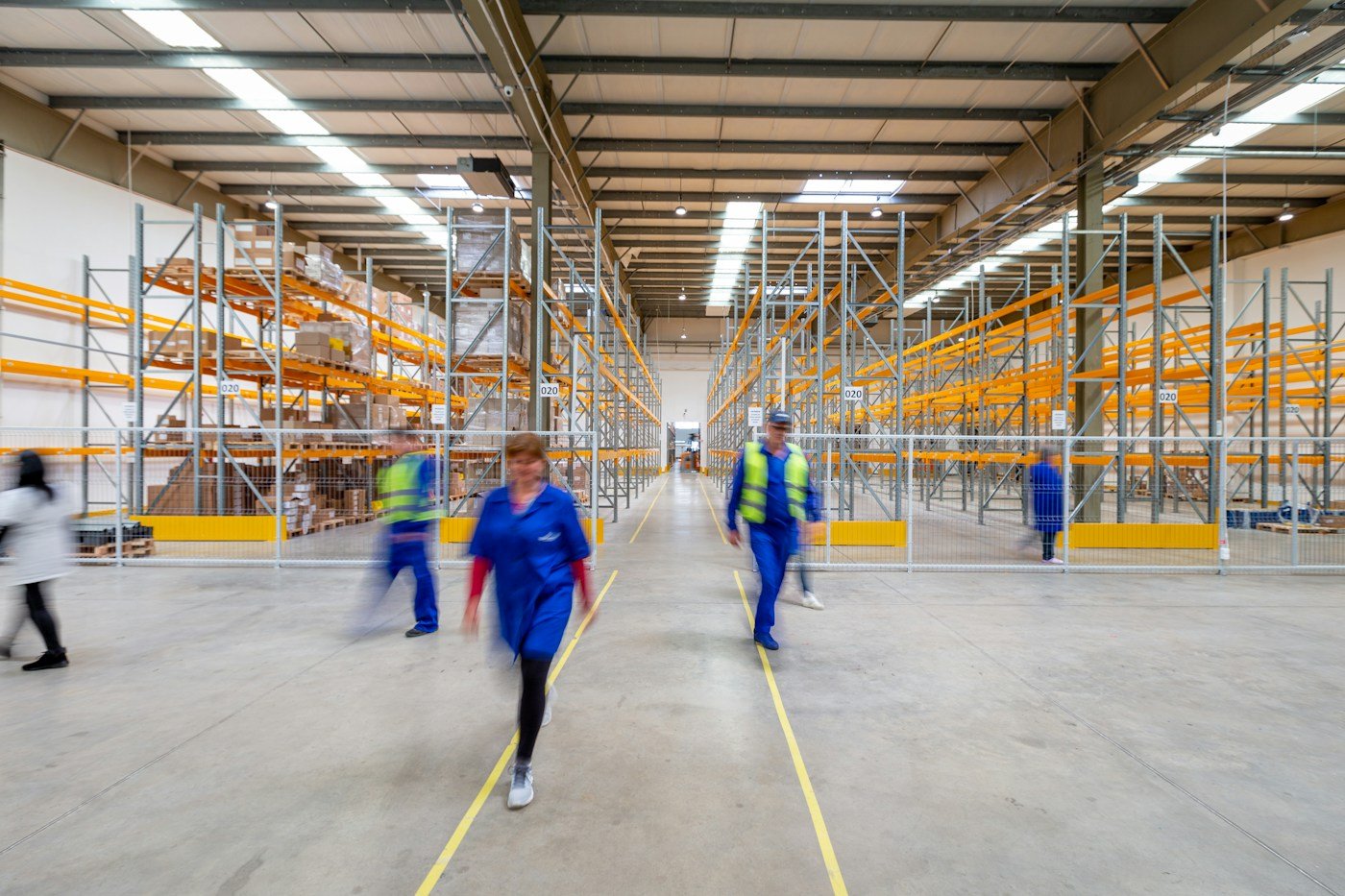
Logistics connects physical goods with delivery decisions. Stock photograph. Credit: Adrian Sulyok / Unsplash.
The Nvidia Palantir supply chain partnership starts with a problem that a benchmark cannot solve: a powerful AI system is still useless if a necessary part has not arrived.
On 10 September 2026, the companies announced a collaboration combining Nvidia’s AI and optimization tools with Palantir’s operational software. Nvidia’s own supply chain is the first deployment setting. The intended goal is to connect scattered information, assess disruptions and help people make better decisions. Joint announcement
It is an unusual loop: the company supplying much of the AI boom is using AI to help manage the machinery behind that boom.
Inside the Nvidia Palantir supply chain approach
An AI rack depends on more than processors. Memory, networking, power equipment, cooling and other components must come together. Nvidia’s announcement combines its Nemotron models and cuOpt software with Palantir’s Foundry, AIP and Ontology products, while retaining human decision-makers.
The announcement describes deployment options intended to keep organizations in control of sensitive operational data. It does not supply an independently audited before-and-after result showing how many delays or costs the system has already removed. Nvidia’s description of the deployment
Giving software a usable map of the business
Palantir’s “Ontology” sounds abstract, but the underlying idea is practical. It connects digital records to real things and relationships: factories, equipment, products, customer orders and the actions people can take.
That could let a planner move from a delayed part to the orders affected by it, instead of separately searching several disconnected records. The example illustrates the approach; it is not a disclosed result from Nvidia’s rollout. Palantir’s technical explanation

There is an important difference between summarizing a problem and choosing a workable response. A fluent paragraph about late deliveries is helpful only up to a point. Someone still needs to decide which scarce components go where.
Optimization does the constrained arithmetic
Nvidia cuOpt is built for mathematical optimization, including logistics and routing problems. Such tools search for useful solutions while respecting restrictions: available vehicles, capacity, deadlines or other limits.
A hypothetical manufacturer could compare delivery plans while keeping within shipping capacity and customer commitments. The software is evaluating choices inside the constraints provided; it is not making a missing part appear. Nvidia’s documentation also explains that some large routing problems use methods aimed at finding strong solutions within a practical time limit, rather than exhaustively testing every possibility. cuOpt documentation
This places an everyday test beside the grand AI promises. Do planners discover trouble earlier, make fewer errors and recover from disruption faster? Those outcomes will be more informative than a compelling demo.
The same physical constraints appear in Nvidia’s power-efficiency story. Software can improve how a system is run, but the chips, electricity and cooling still have to exist.
For now, the partnership establishes an ambitious operational deployment. Its strongest proof will come when the companies can show that better-connected information led to measurably better deliveries.
Leave a Reply