
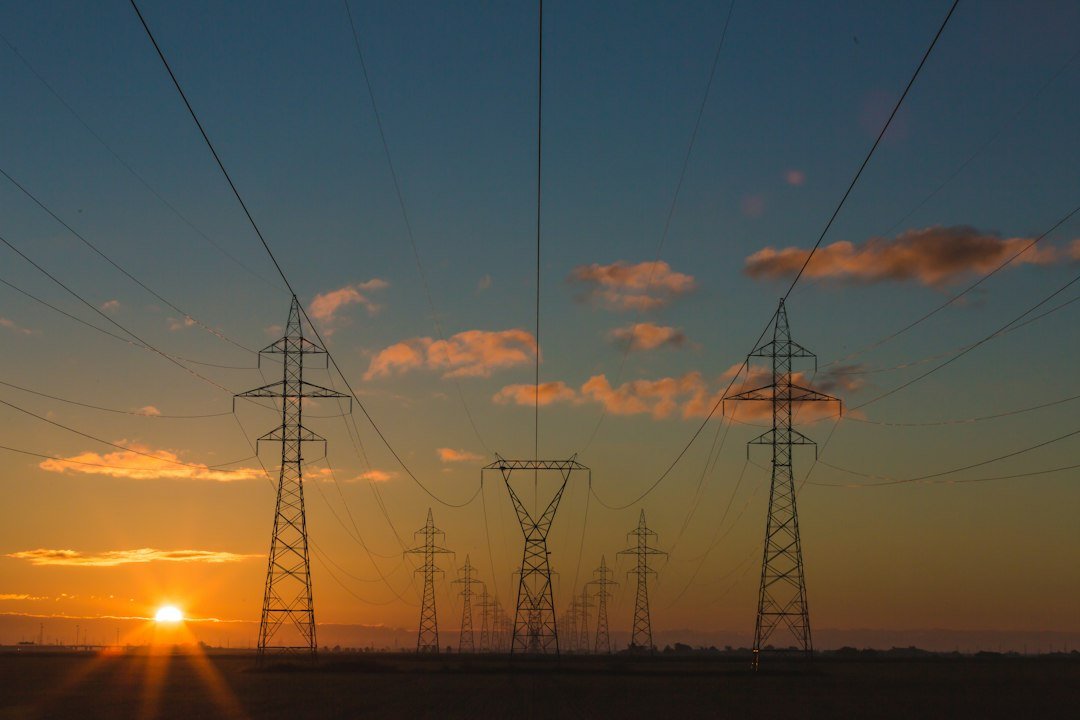
Featured image: Electricity pylons illustrate a network that must coordinate generation and demand. Contextual photograph; not an AEMO curtailment event or a verified Australian solar-farm connection. Photo: Matthew Henry / Unsplash. Unsplash licence.
A sunny day can produce electricity that a solar farm never sends to consumers. The panels may be ready to generate, yet the network cannot accept all the output or the market selects cheaper offers. These outcomes look similar at the plant’s meter, but they point to different causes.
AEMO’s Quarterly Energy Dynamics report for April–June 2026 provides a useful distinction. This explainer uses those measured market outcomes, published in July, to examine a continuing grid problem. It is not a claim that new October curtailment figures have been released.
Network limits and market offers are different
In AEMO’s definitions, network curtailment means output falls below the level economically available because network or security constraints intervene. Economic offloading means a generator is dispatched below its maximum availability because competitors offer output at lower prices. One concerns operating constraints; the other concerns the offers selected by the market.
The distinction prevents a misleading diagnosis. A plant losing output through a constrained connection may need a different solution from one whose offers are repeatedly uncompetitive. Describing both simply as wasted solar can obscure which investment or operating change would address the cause.

The figures describe available generation
AEMO reported average grid-scale solar network curtailment of 81 megawatts in Q2 2026, equivalent to 4.0% of average solar availability. Wind network curtailment averaged 61 megawatts, or 1.4% of wind availability. The report’s curtailment section presents these separately from economic offloading.
Those percentages concern the available output of the relevant generation, not all electricity consumed in Australia. The megawatt values are averages over the quarter, rather than a single plant’s rated capacity. Reading the denominator and time period is essential before using the figures to describe the scale of unused energy.
Storage helps only when its location and timing fit
A battery can absorb output and release it later, but the word storage does not resolve every constraint. As an engineering inference, a battery must be able to charge at the relevant place and time, have spare capacity, and eventually deliver its stored energy. A fully charged battery cannot absorb another surplus indefinitely.
Likewise, a battery downstream of a congested network section may not help a generator upstream of it. A connection study would need to establish the effect. Demand that can move into the surplus period offers another route, but only where the electricity can reach that load. These are possibilities to assess, not results claimed for a specific project.
Some unused output can coexist with a cheaper system
National-laboratory research has examined curtailment as a tool in grids with more wind and solar. It notes that reducing output can help operators respond to changing system needs and maintain reliability. Avoiding every unused unit of generation is therefore not the only objective.
The economic trade-off is easy to illustrate. A network upgrade used only during a few exceptional surplus periods might cost more than the energy it recovers. In other circumstances, frequent congestion could make an upgrade highly valuable. This is an illustrative comparison; evaluating a real project requires its actual costs and operating data.
The useful target is delivered energy at the right time
The National Electricity Market figures also should not be treated as measurements for Western Australia’s separate Wholesale Electricity Market. Different networks, generation patterns and market arrangements produce different outcomes. AEMO’s report covers both systems, but the curtailment figures cited here come from its NEM section.
A clearer energy debate distinguishes technical restrictions, market selection and ordinary variation in sunlight. It then asks which changes improve delivery, reliability and total system cost. Solar capacity is the starting point. Understanding why available output goes unused is part of turning that capacity into useful electricity.
The two categories should also remain separate when assessing a proposed remedy. Recovering output previously blocked by a network restriction is a different result from changing which offers clear the market. Both may improve a generator’s position, but they demonstrate different changes in the electricity system.
Leave a Reply