
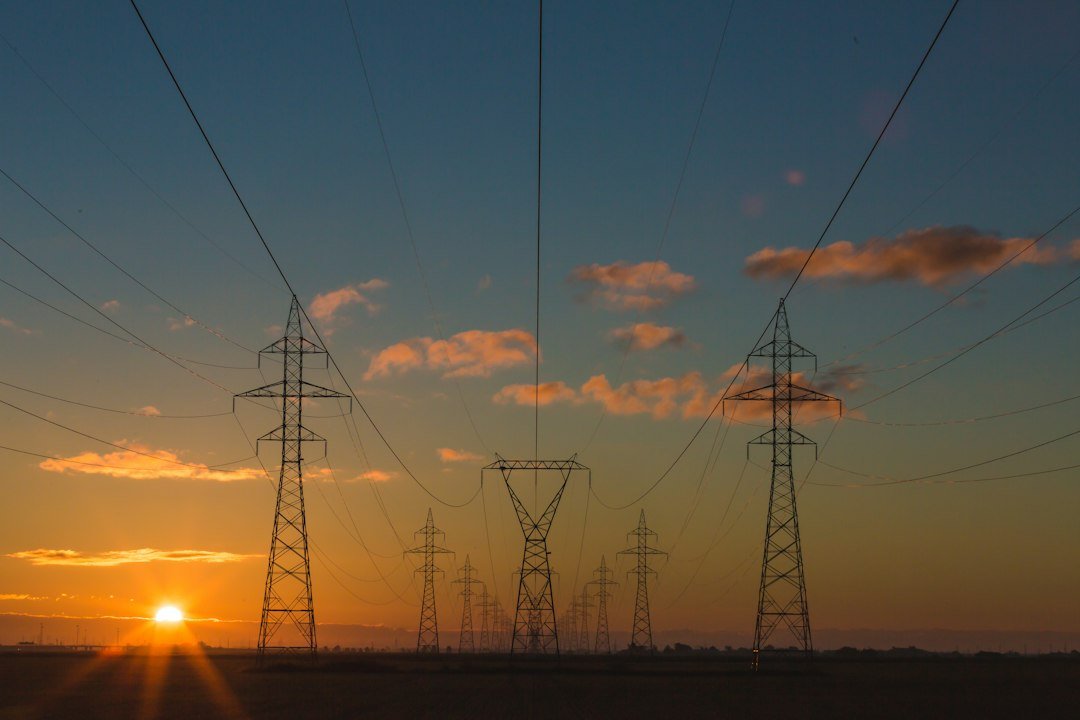
Featured image: Transmission lines illustrate high-voltage infrastructure. Contextual photograph; not Blackhillock, Davenport or Robertstown, and no synchronous condenser is shown. Photo: Matthew Henry / Unsplash. Unsplash licence.
A power grid can have enough electricity available and still need help remaining electrically stable. One response looks surprisingly familiar: a large spinning machine resembling a generator, but without a turbine continually driving it to supply electricity.
This is the synchronous condenser. It is established equipment with renewed relevance, not a newly discovered energy source. A Foresight announcement dated 7 September 2026 offers a recent example: the acquisition of Blackhillock in Scotland, an asset the company says has operated since July 2025.
Three useful services are hidden behind one machine
The European transmission operators’ association ENTSO-E describes synchronous condensers as rotating electrical machines that provide adjustable reactive power, fault-current contribution and synchronous inertia.
Reactive power supports voltage in an alternating-current network. It is not the same as the active power that performs useful work in appliances. Fault-current contribution helps the network respond to disturbances and supports protection systems. Inertia comes from rotating mass and helps resist rapid changes in frequency.
These functions should not be collapsed into a single generation number. A project can provide valuable electrical support without supplying continuous energy to cover a city’s consumption. Its role is closer to maintaining operating conditions than filling a shortage of fuel or sunshine.
The shaft can spin without a working power station
Siemens Energy’s technical explanation describes a machine connected to the high-voltage system through a transformer. A motor or starting converter brings it to operating speed; it then runs synchronously with the network rather than being driven by a power-producing turbine.
Controlling its electrical excitation allows it to provide or absorb reactive power. Adding a flywheel increases rotating mass and the available inertial response. These are different design choices from installing more stored chemical energy in a battery.
Inertia is not an unlimited energy supply. The relevant benefit is the machine’s response during a disturbance, buying time for other controls and resources. A spinning rotor cannot keep compensating indefinitely for a sustained imbalance between electricity supply and demand.
That is why a condenser does not remove the need for energy-producing equipment, storage, operating reserves or transmission. It supplies particular network services within that wider system.
Operating examples separate a real asset from a proposal
Foresight says Blackhillock provides approximately 2 GVA of short-circuit level, supporting voltage recovery after disturbances. That figure describes electrical network strength; it does not mean the facility generates two gigawatts of continuous power. The September announcement was an ownership change, not the start of a brand-new power station.
Australia supplies an older operational reference. AEMO records four commissioned synchronous condensers in South Australia, with two at Davenport and two at Robertstown. Its account dates the implementation of transfer-limit advice for four-unit operation to 25 November 2021.
AEMO also describes assessing multiple functions before reducing the required number of synchronous generators. That history illustrates the value of system studies: adding one technology does not automatically settle every operational requirement.
Useful support still has losses and a location
ENTSO-E notes that synchronous condensers consume active power through losses and carry mechanical-maintenance requirements. They are not free stability, even when no fuel-burning turbine is attached.
Location also matters. Siemens distinguishes the importance of network position for reactive-power and short-circuit support from the somewhat more flexible siting of inertia. A national total can therefore conceal a local weakness that still needs addressing.
The broader lesson is that a clean-power transition has several engineering jobs. Producing energy, moving it, storing it and keeping the network stable are connected but distinct. Synchronous condensers make one of those less visible jobs concrete: preserving useful properties of a rotating generator while separating them from continuous electricity production.
Reporting and source checks completed on 19 October 2026. By FutureTechDose Editor.
Leave a Reply