
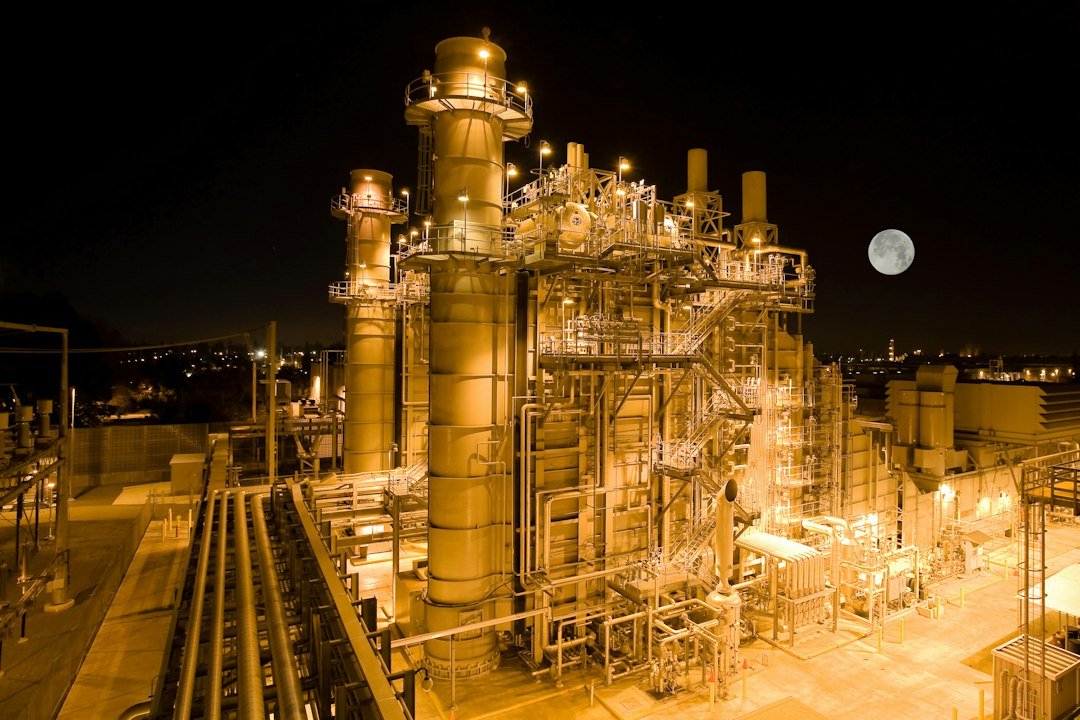
Featured image: An industrial power facility illustrates dedicated generation. Contextual photograph; not a Venture Global site or equipment ordered under the new agreements. Photo: American Public Power Association / Unsplash. Unsplash licence.
The rush to power AI is drawing companies with experience operating their own industrial electricity systems into the data-centre business. Venture Global wants to use its gas and power infrastructure as the foundation for a much larger computing opportunity.
On 15 October 2026, Venture Global announced agreements with GE Vernova and Baker Hughes Energy Services covering equipment for up to 16 new 720 MW power islands. The company describes a potential pathway to up to 10 GW of compute capacity by the end of 2034. Those are contingent plans, not electricity or computing capacity already available.
Island mode moves the responsibility inside the project
An island-mode electricity system operates independently of the public grid. Here, the proposed power islands use combined-cycle gas turbines and related equipment. Venture Global says the approach would support its LNG business and potentially adjacent data centres.
The company argues that dedicated generation and closed-loop water systems would avoid additional demand on public electricity and water utilities. That is a developer claim about the proposed arrangement. It should not be treated as independent confirmation that every local resource, environmental or cost question is resolved.
Our interpretation is that grid independence changes where the engineering responsibility sits. The operator still needs fuel, equipment, maintenance, redundancy and a system that can keep serving demand when a component is unavailable.
The filing separates a framework from an order
The SEC filing dated 15 October records agreements signed on 9 October. It describes an initial manufacturing reservation for eight additional power islands and five initial reservations for transformer and switchgear packages, alongside further steps needed to place orders.
The filing says the combined amount payable would be approximately US$17.2 billion if all purchase orders under the power and grid frameworks proceed, subject to adjustments. That conditional total is not the same as all the equipment having been purchased or paid for.
Outside specified reservations and fees, further binding purchase or supply obligations depend on additional agreements or orders. This distinction matters because a reserved manufacturing pathway can reduce one kind of uncertainty while leaving the scale and timing of construction undecided.
Generation and computing capacity are different numbers
Sixteen units at 720 MW represent a potential 11.52 GW of power-island nameplate capacity. The company’s separate ambition is up to 10 GW of compute capacity. Readers should not add those figures or assume they describe the same operational quantity.
The announcement says deployment will be staged according to customer commitments, market demand and commercial needs. It expects the first power-island purchase order by the end of 2026 and says it will work with regulators on additional permits.
Reuters’ 15 October coverage places the agreements in the wider interest in dedicated power for AI facilities. The immediate development is access to an equipment framework. A customer-ready data centre would still require the computing building, its power and cooling systems, networking and commissioning.
The next milestones are physical and contractual
The useful disclosures to watch are specific orders, permit decisions, construction progress and customer commitments. A forecast of a large addressable opportunity cannot substitute for those delivery milestones.
An operating project would also need measured reliability and resource data. Off-grid generation can avoid one connection bottleneck while retaining dependencies on gas supply, machinery and site infrastructure. Evaluating the complete system requires evidence from operation.
Venture Global’s proposal is significant because it brings an established industrial power model to the AI buildout. Its scale makes careful labelling more important: the agreements create options and initial reservations, while the claimed computing capacity remains an ambition that must be built in stages.
Reporting and source checks completed on 15 October 2026. By FutureTechDose Editor.
Leave a Reply