
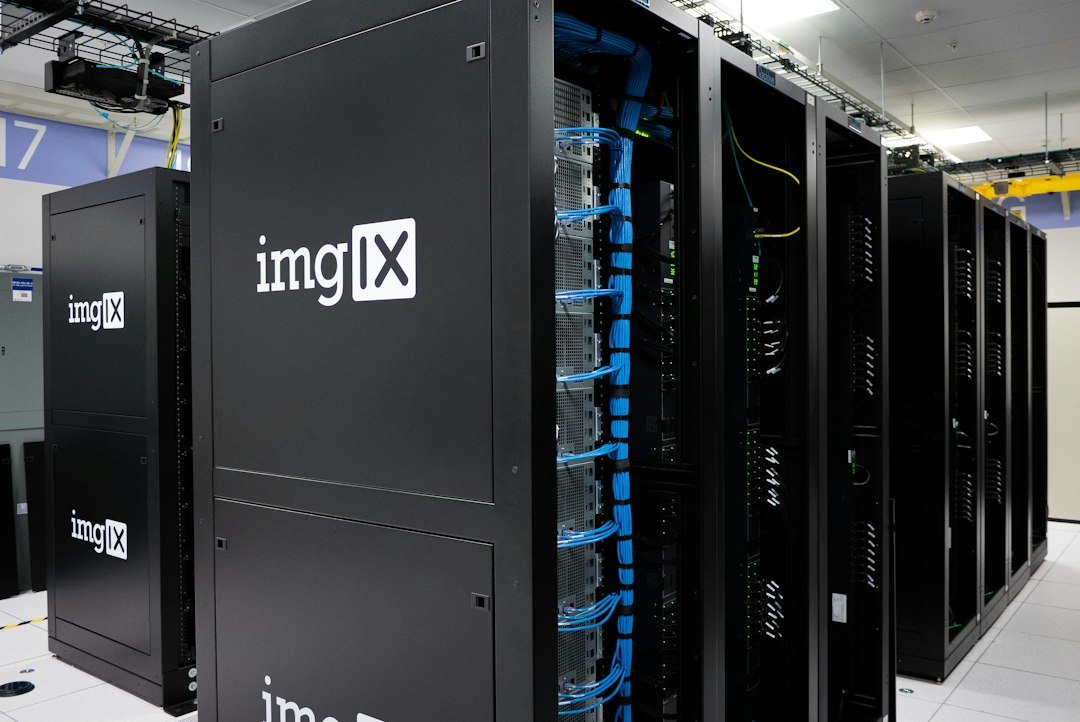
Featured image: Server cabinets illustrate large-scale computing. Contextual photograph; not CERN’s data centre, Mistral training hardware or the proposed Large Physics Model. Photo: imgix / Unsplash. Unsplash licence.
Training an AI model for particle physics means confronting a different environment from ordinary text generation: immense simulated datasets, specialised detector signals and conclusions that must survive unusually demanding scientific checks.
On 15 October 2026, CERN announced a statement of intent with Mistral to establish a long-term partnership on foundation models for science. Its ambition is a Large Physics Model trained on billions of simulated proton–proton collisions. The agreement describes a research direction; it does not announce a finished model or an AI-discovered particle.
The proposed model would span several scientific tasks
A foundation model is trained broadly enough to support more than one downstream task. CERN describes potential uses from reconstructing collisions and identifying particles to flagging unexpected signals and evaluating detector designs.
Current reconstruction turns detector signals into objects used for physics analysis through chains of specialised algorithms. The proposal is to investigate whether a shared model can learn across more of that chain. Whether one model can reliably support those tasks is part of the research question.
The training material is simulated collisions, rather than a direct feed of every experimental event into an already working system. Comparing simulation with real detector behaviour will be central to judging any result.
Scientific AI already depends on distributed infrastructure
The Worldwide LHC Computing Grid describes a collaboration of around 160 computing centres in more than 40 countries. It supplies resources to store, distribute and analyse LHC data. That existing network is background infrastructure, not a new data-centre commitment announced in the Mistral agreement.
CERN says around one exabyte of experimental LHC data has been stored to date. An exabyte is approximately one million terabytes. The size makes data organisation, movement and access part of the model-development problem, alongside the processors used for training.
Our interpretation is that scaling scientific AI requires the data pipeline to be treated as seriously as the model. A training run is only as useful as the traceability of its inputs, the quality of simulation and the ability to reproduce its evaluation.
A shared model needs task-specific tests
A network that identifies known particles well might still behave poorly on rare events or unexpected detector conditions. Conversely, a system designed to flag anomalies can generate interesting alerts without proving that any alert represents new physics.
A credible evaluation would therefore separate reconstruction quality, calibration, robustness and scientific sensitivity. It would compare with the relevant specialised systems and explain where a shared model improves performance or introduces new uncertainty.
Reuters’ 15 October report notes that the organisations disclosed no specific budget or development timetable. The statement should consequently not be treated as a committed delivery date, a specified compute purchase or a quantified saving in analysis costs.
The coming data scale makes the question timely
CERN expects the High-Luminosity LHC upgrade to increase the number of collisions tenfold, with operation expected around 2030. That is a future programme expectation, not today’s data rate. It explains why the organisations are investigating new analysis methods before the larger workload arrives.
Potential applications beyond particle physics remain prospective. A useful scientific model in one domain would not automatically transfer to drug discovery or other fields without appropriate data and validation.
The partnership matters for AI infrastructure because it joins large-scale model training to a demanding scientific data system. The decisive milestone will be reproducible evidence that the resulting model helps defined tasks, with reliable treatment of uncertainty. Until then, the Large Physics Model is an ambition to build and test.
Reporting and source checks completed on 15 October 2026. By FutureTechDose Editor.
Leave a Reply