

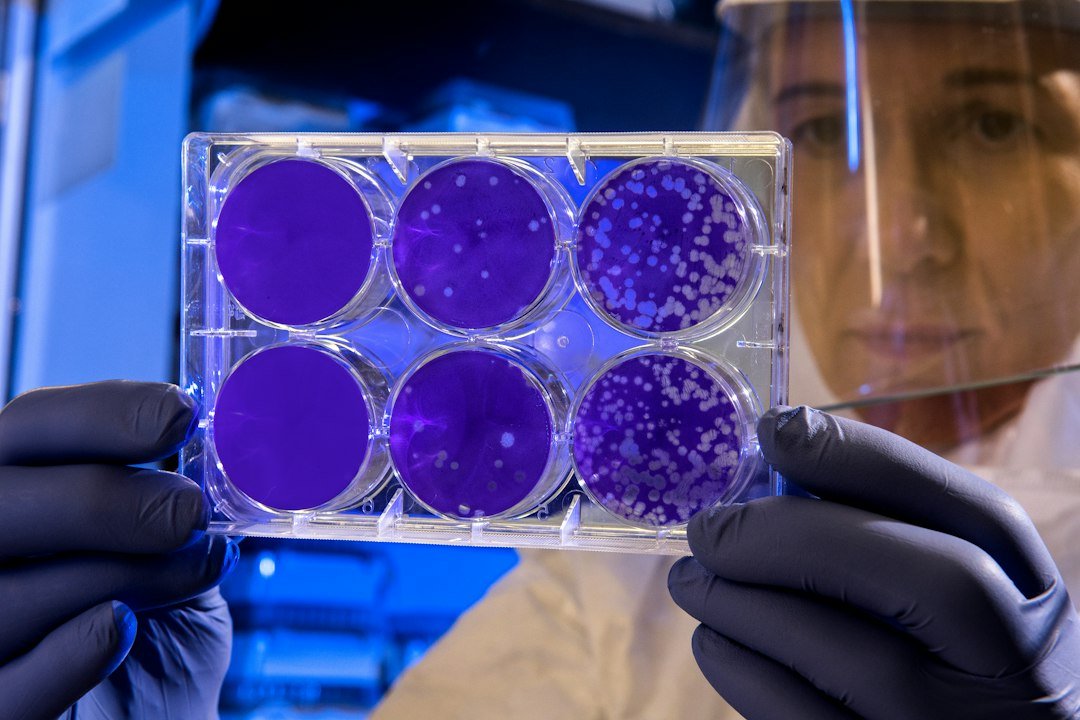
Featured image: Contextual university laboratory; not the mouse or cell experiments reported in the paper. Photo: Trnava University / Unsplash. Unsplash licence.
In brief: Researchers found that individual edited cells can carry different unintended CRISPR changes and that the pattern of edits varies among mouse organs. Some events disappeared when samples were averaged together, suggesting that safety tests may need both greater sensitivity and tissue-specific design.
Gene editing is usually judged by two questions: did it change the intended DNA, and did it alter anything else? A study in Nature Communications shows why the second question is harder than one sequencing result can make it appear.
The open-access paper, published on 26 August 2026, analysed CRISPR–Cas9 outcomes in mouse embryos, mouse embryonic stem cells, human blood-forming stem and progenitor cells, and inducible mouse models. It is preclinical safety research, not a clinical trial and not a report of injuries in people who received an approved gene therapy.
Bulk sequencing can hide a rare cellular history
CRISPR–Cas9 uses a guide RNA to bring a DNA-cutting enzyme to a chosen sequence. Similar sequences elsewhere in the genome can sometimes be cut as well. Repair can create small insertions or deletions, and simultaneous breaks can be joined into chromosome rearrangements called translocations.
Standard analysis often mixes DNA from thousands or millions of cells. A rare change may then fall below the error floor of the sequencing method. The researchers instead expanded individual edited cells into clones or amplified DNA from single cells, allowing each cell’s editing history to be examined with less dilution.
Cells edited at the same stage with the same deliberately promiscuous guide showed distinct off-target and translocation profiles. Several events found in individual clones were not detectable in pooled cells or in a “pseudobulk” average calculated from the single-cell results.
Specific guides still performed better
The experiment included a guide designed to have many similar genomic targets and a second, more specific guide intended as a therapeutic-style comparison. The promiscuous guide produced far more off-target events. The specific guide showed low-frequency unintended edits under the sensitive single-cell workflow, but no translocations were detected in the tested mouse embryo or embryonic-stem-cell clones.
In human blood-forming stem and progenitor cells, guides associated with the approved Casgevy editing strategy and another specific target produced no detected off-targets in the analysed clones. A deliberately promiscuous guide did, and a higher-fidelity Cas9 version reduced the number of detected sites.
Those comparisons matter. The paper does not argue that all CRISPR editing is broadly unsafe; it shows that guide design, enzyme choice and detection method strongly affect what is observed.
Organs repaired DNA differently
In mice engineered so Cas9 activity could be switched on, the team compared multiple tissues. Off-target patterns, small mutation types, DNA-repair-pathway use and the tendency to form translocations varied among organs.
Chromatin helps explain part of the difference. DNA is packaged with proteins, and some regions are more open and accessible than others. The study linked editing to open chromatin and lower methylation in several analyses, suggesting that sequence similarity alone cannot fully predict where Cas9 may act.
A therapy aimed at the liver may therefore require validation in liver-relevant cells and tissue, not only a generic cell line. An assay that works in rapidly dividing cells may also miss outcomes that emerge differently in neurons or other non-dividing tissues.
The method has its own blind spots
Clonal expansion can select against cells with damaging edits, and targeted sequencing only sees sites included in the panel. The translocation workflow could not detect every possible unbalanced rearrangement. The authors used additional approaches, including whole-genome amplification and exploratory long-read sequencing, but no single assay captures every rare event.
This is why regulatory safety packages use multiple, complementary methods. Computational prediction, cell-free nomination assays, targeted deep sequencing, chromosome-structure tests and long-term animal work answer different questions.
The practical lesson is not that a hidden mutation was proven dangerous. It is that “no off-target detected” means no event was found within the sampled cells, tissues, sites and detection limits. Better single-cell and organ-specific testing can make that statement more informative before an editor reaches a larger clinical population.
Leave a Reply