

Featured image: A DNA helix represents the molecular medium used in DNA data-storage research. Conceptual illustration; not DNA-SaM’s experimental strands or a visual measurement of archive capacity. Illustration: Warren Umoh / Unsplash. Unsplash licence.
A hard drive stores information in an engineered physical medium. DNA data storage makes a more unusual choice: translate the information into molecular sequences, manufacture those sequences and later read them back. The attraction is density. The challenge is building an entire usable storage system around it.
A Nature Communications paper published on 19 October 2026 presents DNA-SaM, a codec and indexing architecture. A codec converts information into a storage representation and back again. This is research, not a consumer cloud drive.
Writing a file and reading it are different physical jobs
For a historical benchmark, University of Washington and Microsoft researchers reported in February 2018 that they had encoded and retrieved 35 files totalling more than 200 megabytes. Their archive included video, audio, images and text.
The associated peer-reviewed study used more than 13 million short DNA molecules and demonstrated retrieval of individual files. This is called random access: recover the wanted file rather than decoding every item in the pool.
That older result separates two ideas often collapsed into one headline. DNA can carry digital information, but a useful archive also needs a way to find the relevant pieces. A dense collection of molecules with no dependable addressing or reconstruction method is not yet a practical substitute for organised storage.
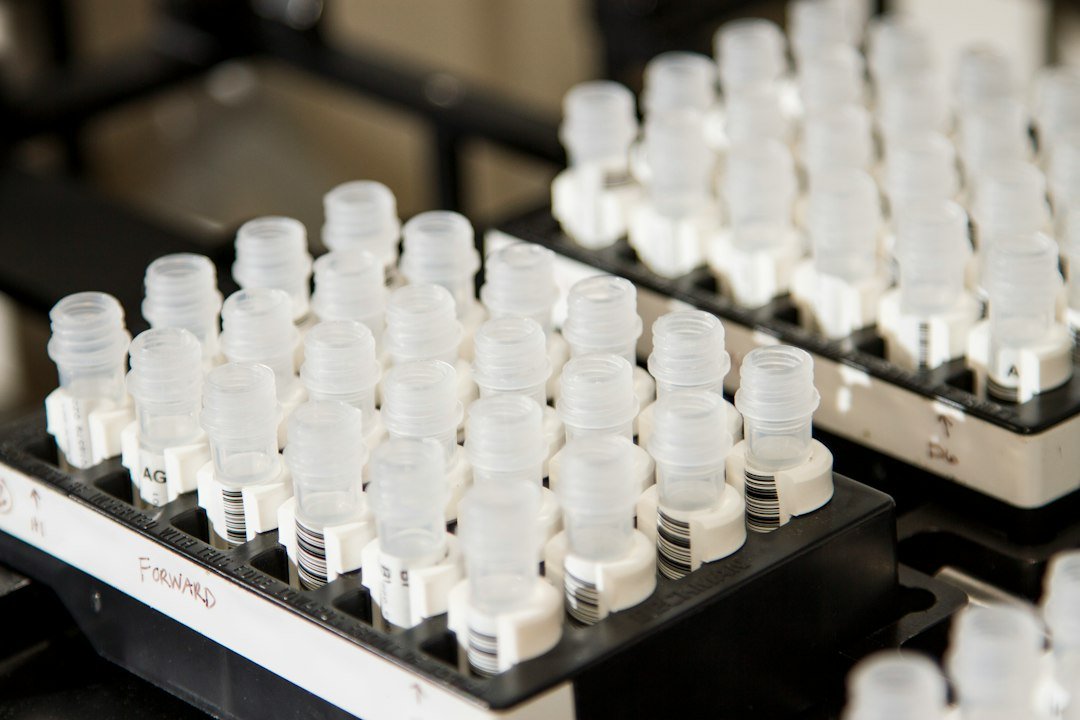
A storage alphabet must obey chemistry
DNA-SaM screens out problematic sequences, including repetitive patterns, and uses two-tier indexing. The authors report encoding 4.33 MB in wet-laboratory experiments; their terabyte-scale analyses were computer simulations, not physical archives. Separate experiments kept encoded information in E. coli bacteria, not human patients.
Recovery also depended on experimental conditions, with data loss at low molecular copy numbers. The enormous theoretical design space is not a measurement of a physically written archive. Those boundaries separate a proposed architecture from deployed capacity and reliability.
The wider issue is that a molecule is not an abstract string of letters. Encoding choices have to remain compatible with subsequent physical handling. An efficient representation in software can become a poor storage choice if the sequences are difficult to manufacture, copy or read.
Redundancy protects data but changes the density calculation
A separate 2026 Nature Communications benchmark of six existing codecs explains why raw bits-per-letter figures can mislead. DNA workflows can introduce substitutions, insertions, deletions and the loss of entire sequences. A recovery scheme must handle more than one kind of damage.
There are also different forms of redundancy. A code can add extra information that helps reconstruct errors. A physical sample can contain many copies of a sequence. Sequencing can read the material repeatedly. These layers interact, so reducing one form of overhead does not automatically make the complete system denser or cheaper.
The benchmark combined computer tests with laboratory experiments under standardised conditions. Its broader lesson is methodological: comparisons need to hold relevant conditions steady. A stronger result on a friendly simulated error pattern is not automatically a stronger result after real synthesis and sequencing.
A credible archive needs an end-to-end test
For future systems, a useful report would identify the actual amount of unique data written, the molecular material used, retrieval accuracy, access time and the work required to reconstruct a file. Cost needs to include writing and reading, not just the encoding program.
These are evaluation criteria, not shortcomings demonstrated for every DNA-SaM component. They keep different kinds of progress in proportion. A faster codec can be valuable even while physical writing remains expensive; an elegant address space can matter without yet corresponding to a warehouse-scale archive.
The promising development is that DNA storage is increasingly being treated as a systems problem. The molecules, the code and the retrieval procedure all have to work together. Winning one of those contests does not eliminate the others.
Reporting and source checks completed on 20 October 2026. By FutureTechDose Editor.
Leave a Reply