
Animal testing alternatives could shape the next important advance in medicine before a patient receives a single dose. It could start with a better way to decide which experimental drugs deserve to reach people at all.
On 21 September 2026, the US Food and Drug Administration announced a regulatory update intended to make clearer that appropriate non-animal methods can contribute to drug safety testing. These include human-cell systems, organ chips and computer models. The announcement also introduced a database with 25 examples drawn from previous regulatory reviews. FDA announcement
For a field increasingly able to build living tissue models and analyse biology computationally, that is worth watching. But the real story is more precise than “AI replaces lab animals.”
Animal testing alternatives get clearer recognition
The rule replaces references to animal tests with the broader term nonclinical tests in parts of the regulations. Nonclinical means evidence gathered outside studies in people; it can include both animal and non-animal methods. This aligns the wording with changes Congress made in 2022, rather than inventing permission to use alternatives for the first time. Federal Register rule
The FDA explicitly says the update does not ban animal studies or lower its evidence standards. Developers still need a scientifically suitable approach for the particular drug and safety question. FDA announcement
There is also a timing detail. Published on 22 September, this is a direct final rule, with an effective date of 4 February 2027 and comments due by 7 December 2026. Significant adverse comments could trigger withdrawal and further rulemaking. It is not an overnight switch in laboratory practice. Federal Register
The “chip” contains living cells
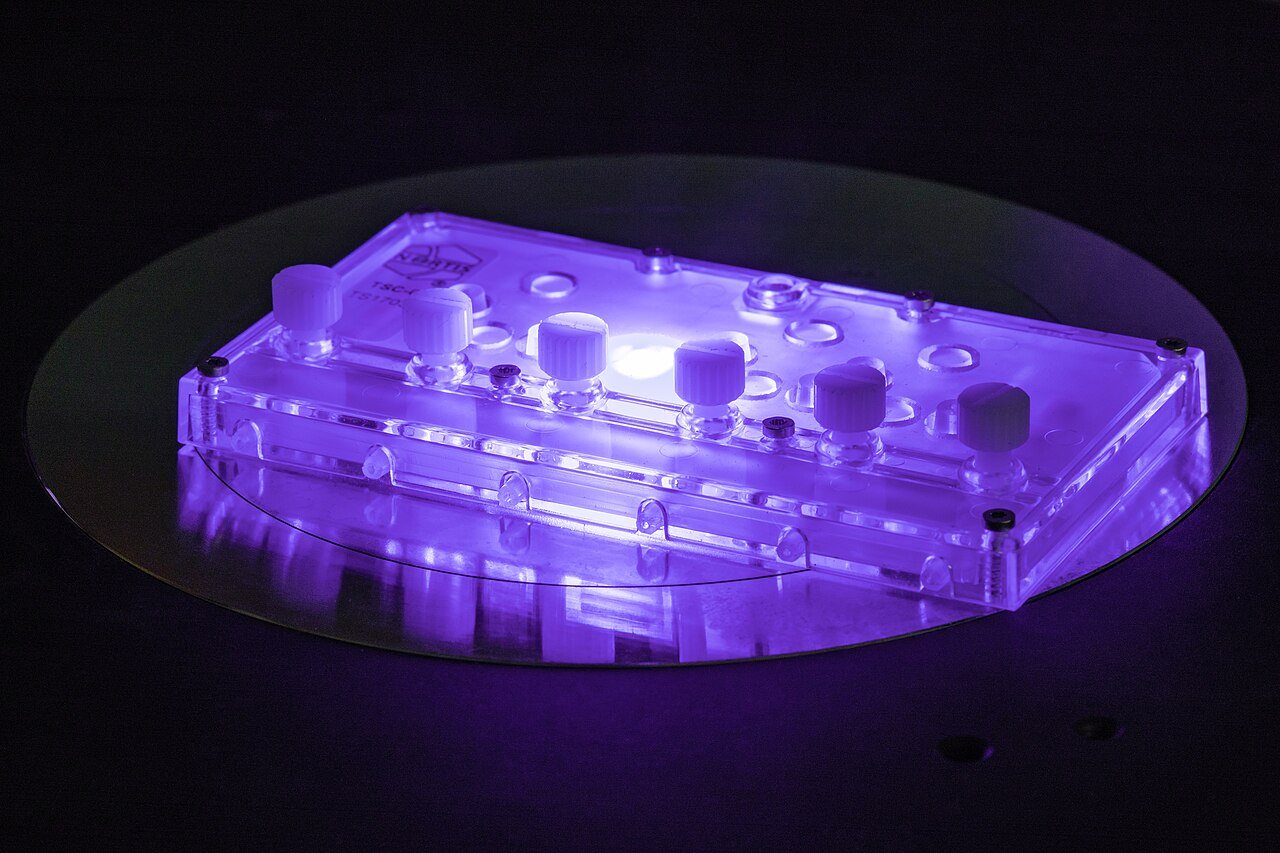
An organ-on-a-chip is not a miniature computer pretending to be a liver. It is a bioengineered device containing human cells, designed to reproduce selected features of an organ’s structure and function.
Researchers can use these systems to investigate how a substance affects tissue resembling the heart, lungs, kidneys or other organs. Their appeal is straightforward: human cells can reveal responses that another species does not reproduce well. NIH’s tissue-chip programme is developing these tools to improve predictions of drug safety and toxicity. NIH tissue-chip overview
That does not make a chip a complete person. NIH also cautions that non-animal approaches need further improvement before they could completely replace animal models. Linking multiple tissue systems is one research direction—not evidence that an entire human body has already been recreated in a laboratory device. NIH
The useful part is proof, not the label
The FDA groups a wide range of approaches under New Approach Methodologies, or NAMs. They include human-based laboratory systems and computational modelling; AI is one possible tool, not a requirement. FDA’s NAMs overview
Its March 2026 draft guidance describes four central considerations: the precise intended use, relevance to human biology, technical performance and fitness for the task. Put simply, researchers need to show what a test measures, how reliably it does so and why the answer matters for people. That guidance remains a draft with non-binding recommendations. FDA draft guidance
This distinction matters for AI-driven drug discovery. Finding a promising molecule and demonstrating that it is suitable for testing in people are different achievements. The guidance itself distinguishes regulatory evidence from discovery and says drug discovery is outside its scope. A compelling computer prediction is therefore not the same thing as a successful human trial. FDA guidance overview
A database of precedents, not blanket permission
The new database makes the shift less abstract. It lists methods appearing in reviews of approved medicines, including reconstructed-skin irritation tests in applications for remdesivir and Journavx.
Those entries should not be mistaken for proof that the medicines were developed without animal studies. They document particular methods within particular applications. The FDA warns that inclusion is neither approval of a method for every other use nor a guarantee that it will be accepted in a future submission. FDA use-case database
The potential payoff is better decisions earlier: fewer unsuitable candidates advancing, more relevant safety evidence and less unnecessary animal use. Whether those gains materialise depends on the tests themselves, not simply a change in terminology.
This is a regulatory development, not a new treatment approval or a Phase III clinical result. Its significance is the direction of travel: drug testing can increasingly be judged by how well it answers a human safety question, rather than by whether an animal was involved.
Related reading: Stanford’s virtual biotech shows how AI agents are helping researchers investigate drug targets.
Featured photograph: a kidney-on-a-chip research device, shown as an example of tissue-chip technology. Credit: University of Washington photo, shared by NIH-NCATS / Wikimedia Commons (public domain).
.jpg)
Leave a Reply