
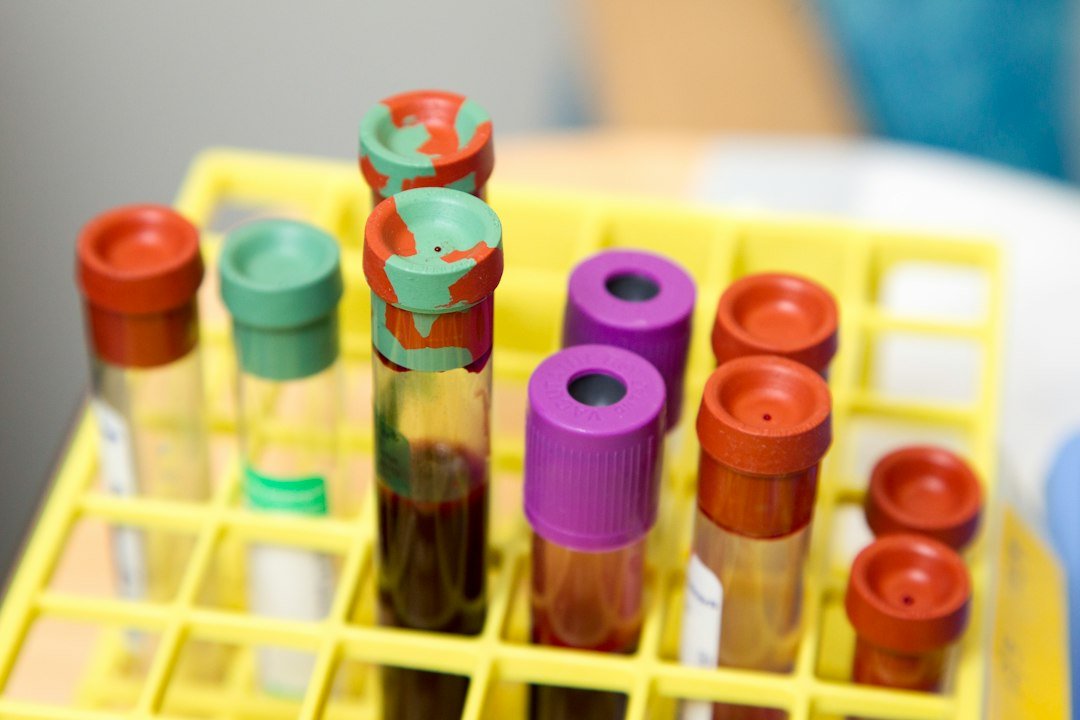
Featured image: Blood vials illustrate the samples used to map immune ageing. Contextual photograph; not material from the Immunity cohorts or a validated diagnostic test. Photo: National Cancer Institute / Unsplash. Unsplash licence.
People of the same age can have very different immune systems. A new study has tried to turn that variation into a map, finding that the balance between two states of an experienced T cell is associated with sharply different health trajectories.
The Immunity study published on 9 October 2026 integrated about 12.4 million individual immune cells from 2,609 mainly healthy adults across eight cohorts. It then connected protein patterns associated with the cell states to years of health records in roughly 50,000 UK Biobank participants. A granzyme B-dominant pattern was associated with chronic disease and higher mortality; granzyme K dominance was linked with healthier ageing. Association does not establish cause, and the result is not a ready-made blood test.
Effector-memory T cells sit on a spectrum
CD8 T cells help recognise and destroy infected or abnormal cells. After an immune challenge, some become effector-memory T cells, abbreviated Tem, which can respond quickly when a familiar threat returns. The study focused on Tem states marked by production of granzyme K, or GZMK, and granzyme B, or GZMB.
Granzymes are proteins used by immune cells. GZMB is strongly associated with the machinery that directly kills target cells. GZMK is less fully understood and may amplify or coordinate inflammatory responses. The labels describe dominant molecular programmes, not two perfectly separate species of cell.
Younger participants were more uniformly enriched for adaptable, naive immune cells. Older immune systems were more varied. Some shifted towards GZMK-positive Tem cells in a pattern the authors associated with a more resilient trajectory, while others showed more GZMB-positive cells and signs of persistent immune activation.

Proteins served as a bridge to long follow-up
UK Biobank did not contain the same single-cell counts for the relevant T-cell states. The researchers therefore used a smaller cohort with both cell measurements and blood proteins to train a model that recognised protein signatures associated with either end of the GZMK-to-GZMB spectrum.
They applied that model to baseline protein samples from about 50,000 UK Biobank participants, whose medical events were tracked for up to 15 years. According to Washington University’s study summary, people whose inferred baseline state leaned towards GZMB later had higher rates of death and conditions including type 2 diabetes, hypertension, liver disease and kidney failure.
This layered design is powerful because it combines detailed cell biology with a large longitudinal resource. It also adds uncertainty: the UK Biobank analysis inferred cell balance from proteins rather than measuring every participant’s cells directly, and many biological and social factors can influence both immunity and disease.
A biomarker must prove more than correlation
The researchers are working towards a simpler assay that could run on standard clinical equipment. Today, positioning someone precisely on the immune-ageing spectrum requires specialised measurements and modelling. No regulator has approved the ratio as a diagnostic, and no clinical threshold tells an individual what action to take.
A useful test would need to reproduce across populations, remain stable enough to interpret and add predictive value beyond age, medical history and existing laboratory measures. Researchers would also have to show whether the signal changes with infection, medication, vaccination or temporary inflammation.
The study’s cohorts covered several ancestries and countries, but no dataset perfectly represents the population in which a test would be used. Calibration, reference ranges and prospective clinical studies would be required before a laboratory could return an individual result responsibly.
Most importantly, changing the marker may not change the outcome. GZMB-dominant cells could contribute to unhealthy ageing, could be a response to hidden disease, or could mark another process that drives both. Intervention studies are needed before the biology becomes a therapeutic target.
The result matters because it resolves “immune age” into specific, measurable cell programmes across unusually large datasets. It offers an early-warning hypothesis grounded in human biology. Its next test is clinical utility: whether the map can predict risk reliably enough to improve decisions, rather than merely describe how immune systems diverged.
Reporting and source checks completed on 13 October 2026. By FutureTechDose Editor.
Leave a Reply