
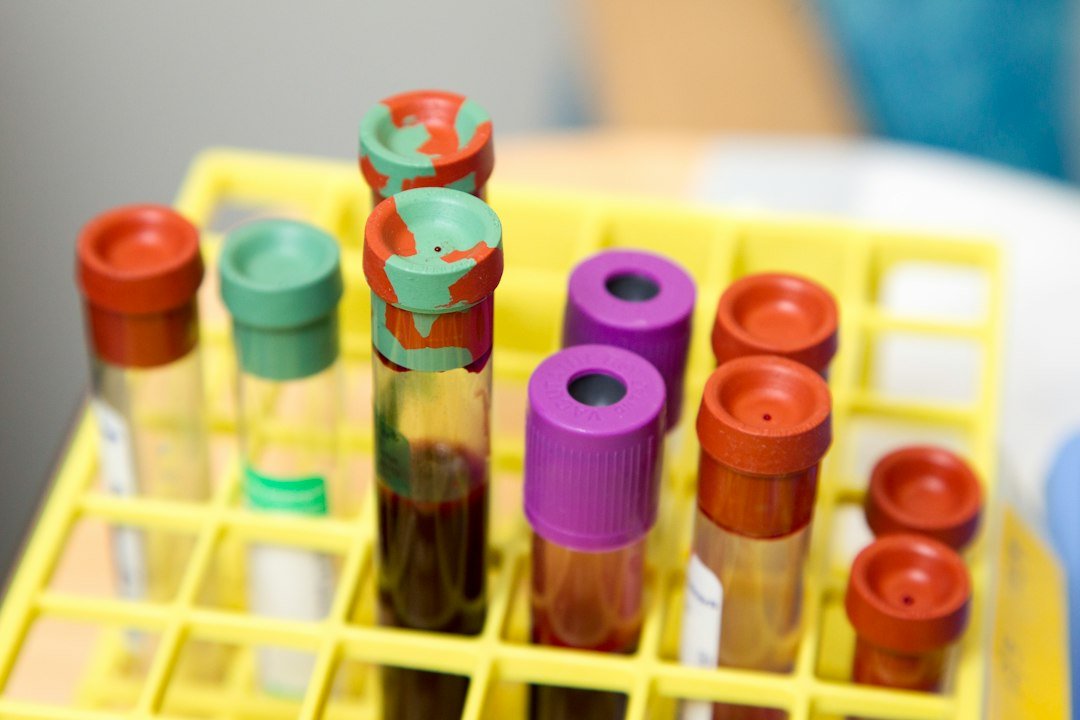
Featured image: Blood-sample tubes illustrate clinical research. Contextual photograph; not LB2501 material or samples from trial participants. Photo: National Cancer Institute / Unsplash. Unsplash licence.
A central step in CAR-T therapy usually happens in a factory: immune cells are removed, genetically altered and returned to a patient. Legend Biotech is testing a different route with LB2501, which is designed to create the engineered cells inside the body.
On 15 October 2026, the company announced US FDA clearance of its investigational new drug application. The milestone enables a planned US Phase I/II study in relapsed or treatment-resistant B-cell cancers. It is permission to investigate a therapy, not approval to market it.
The infused product carries instructions
Conventional autologous CAR-T uses a patient’s own T cells as the starting material. The National Cancer Institute describes a process of collecting them, adding an artificial cancer-recognising receptor, expanding the cells and shipping the final product back.
LB2501 instead uses an engineered lentiviral vector, a modified virus designed to deliver genetic instructions. According to Legend, the vector cannot replicate and is designed to enter T cells selectively. Those cells then produce a receptor targeting the B-cell proteins CD19 and CD20.
Targeting two proteins is intended to reduce one route of resistance: cancer escaping an attack by losing a single recognisable target. Whether this design provides durable benefit must be measured, rather than assumed from the engineering.
The potential manufacturing change is substantial. A ready-made vector could avoid collecting and engineering a separate cell batch for every patient. It would still require controlled manufacture, clinical delivery and monitoring of the biological response.

Trial clearance defines the next step
Legend’s SEC filing records the 15 October announcement. The company says the US study will assess safety, tolerability, how the product behaves in the body and preliminary anti-cancer activity. Its programme is being evaluated without preparatory lymphodepleting chemotherapy.
The FDA’s explanation of an IND separates authorisation for human research from a marketing application. Early trials build the evidence needed for later decisions; clearance does not certify that the experimental approach is effective or safer than alternatives.
For in-body engineering, a key development question is control. Researchers need to know which cells receive the vector, how the engineered population expands and how long it persists. A simpler preparation process does not make these questions disappear.
Earlier Chinese results are background, not the new milestone
LB2501 already has a registered open-label Phase I study in China. Earlier results, included in an EHA conference abstract filed with the SEC, covered 12 patients as of 1 April 2026.
Across both dose groups, six of 12 patients responded and five had a complete response. In the higher-dose group, all six responded and five had a complete response, with median follow-up of only 2.2 months. These were small, uncontrolled, sponsor-associated early results.
Cytokine release syndrome occurred in eight of 12 patients and was grade 1 or 2. The abstract also reported severe reductions in some blood-cell counts. No serious adverse events, dose-limiting toxicities or ICANS neurological toxicity were reported at that cutoff. Those observations do not establish long-term safety.
Keeping the total cohort beside the higher-dose subgroup prevents an eye-catching percentage from standing in for the whole experiment. Longer observation and additional patients are needed to judge durability and less common harms.
Manufacturing inside the body changes the evidence needed
The significance of the new clearance is that another trial can examine whether this delivery concept can work reproducibly in a defined clinical setting. It does not replace comparative evidence or turn the earlier response figures into a prediction for future patients.
If the approach advances, its value will depend on a combination of clinical benefit, controllable biology and practical delivery. The promise is a different way to manufacture a living therapy. The present status is an investigational programme with an early human signal and a newly authorised research path.
Reporting and source checks completed on 16 October 2026. By FutureTechDose Editor.
Leave a Reply