
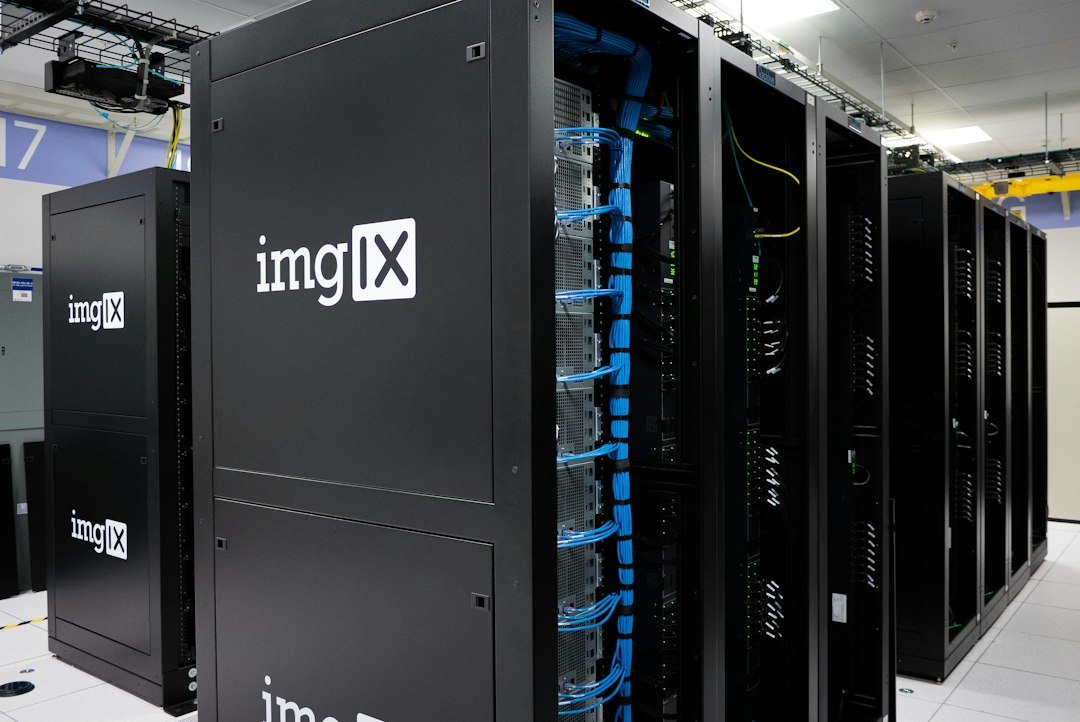
Featured image: Server cabinets illustrate computing infrastructure for research. Contextual photograph; not a Genesis Mission system or infrastructure supplied under NVIDIA’s pledge. Photo: imgix / Unsplash. Unsplash licence.
A larger computing budget can make a scientific experiment possible. It cannot establish that the experiment produced a discovery. The latest expansion of US AI-for-science efforts makes that distinction especially important.
On 8 October 2026, NVIDIA announced a $1 billion commitment over five years to advance US science and quantum computing. The company identified support for higher-education research, quantum computing and cloud providers serving government needs. This is a forward-looking commitment, not a record of completed scientific results. Read NVIDIA’s announcement.
A pledge and a research award are different instruments
NVIDIA’s announcement connects its commitment with the Genesis Mission, a US initiative linking scientific data, computing and research infrastructure. It does not provide a detailed public allocation that would justify describing the entire billion dollars as immediate cash grants to laboratories.
Separately on 8 October, the Department of Energy announced 12 new Phase II Genesis Mission projects totalling $159 million, plus six new Phase I awards. These government project awards are not the same funding pool as NVIDIA’s five-year commitment, so the figures should not be merged into one spending total. DOE’s award announcement.
In this programme, Phase I and Phase II refer to research-project development stages. They are not clinical trial phases and do not imply that a medicine has passed a human efficacy study. The distinction prevents a familiar label from acquiring the wrong meaning.
The research jobs extend beyond conversational AI
DOE’s selected projects include improving enzyme design, modelling underground reservoirs for geothermal energy, optimising scientific software and developing a digital twin of a fusion device. A digital twin is a computational representation used to investigate how a physical system might behave.
These are intended research capabilities. Building a fusion-device model is not evidence of commercial fusion electricity, and improving an enzyme-design model is not approval of a medicine. The project descriptions outline what the teams aim to develop, rather than outcomes already delivered. Descriptions of the selected projects.
Scientific computing also demands a different standard from an impressive demonstration. A useful prediction needs a defined domain, uncertainty estimates and comparison with observations. A system can produce plausible explanations while still choosing the wrong experiment or missing a physical constraint.
The strongest example closes the loop with an experiment
SLAC National Accelerator Laboratory announced a Phase I catalysis project on the same day. Catalysts change the rate of chemical reactions and are central to many energy and manufacturing processes. The proposed system would combine X-ray measurements, electrochemistry, computational models and published evidence to choose the next experiment. SLAC’s description of the project.
That is a closed loop: the model selects a measurement, real equipment produces data, and the result changes the next decision. The system is intended to test competing explanations of how catalysts work rather than merely generate new text about chemistry.
SLAC says Phase I will test whether this approach reaches scientific understanding with fewer experiments than standard methods. That comparison offers a measurable criterion for progress. It remains a planned evaluation, not a demonstrated acceleration announced with the award. The planned evaluation and experimental workflow.
Useful access and reproducible results will decide the value
One practical test is whether researchers can actually use the promised resources with their data and instruments. A nominal allocation loses value if teams lack the software, technical support or permissions needed to run their work. A second test is whether results can be reproduced outside the original demonstration.
An informative progress report would therefore separate resources delivered from resources promised, and model performance from experimentally confirmed findings. It would report failures as well as successful examples and explain whether an apparent improvement survived a fair comparison.
The announcements are significant because they connect industry computing commitments with specific public research programmes. Their scientific value will be earned in the next layer: experiments that yield reliable knowledge more efficiently, with enough evidence for other researchers to check the result.
Leave a Reply