
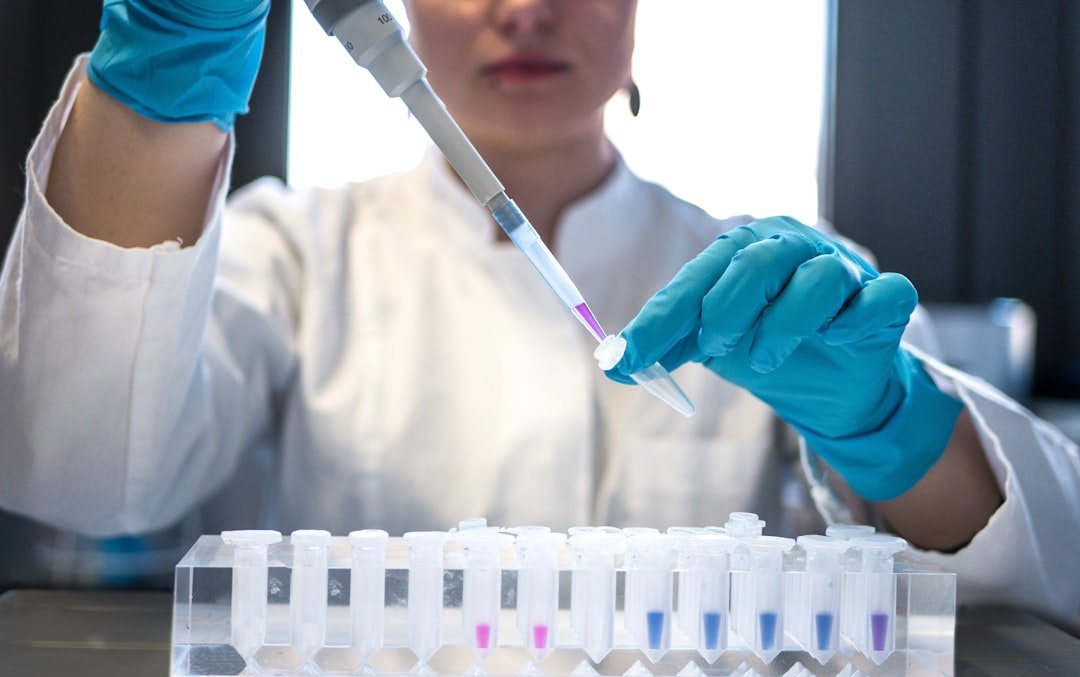
Featured image: A scientist handles laboratory samples. Contextual photograph; not the PPARD experiments or a clinical treatment. Photo: Julia Koblitz / Unsplash. Unsplash licence.
The same protein can help a cancer cell compete or help an immune cell attack it. New research on PPARD makes that apparent contradiction the centre of a possible immunotherapy strategy.
In a Nature Immunology study published on 14 October 2026, researchers found that activating this regulator in immune cells improved tumour control in experimental models. The result does not establish a treatment for patients. It shows why the location of a biological intervention can be as important as its target.
Two competitors share a metabolic switch
PPARD, also written PPARδ, is a transcription factor: a protein that influences which genes are active. It helps regulate how cells use fats. Cancer cells and immune cells both need resources, so improving one competitor’s performance can change the contest between them.
The paper’s abstract in Cold Spring Harbor Laboratory’s repository describes opposing effects. Cancer-cell activation promoted growth and weakened anti-tumour immunity. Activation in immune cells strengthened cancer control, including when cancer cells also had the pathway switched on.
The work connected the immune effect to fat-burning processes and changes in how T cells access and use genetic instructions. This is a cellular engineering result. It does not imply that changing a person’s diet would reproduce the effect.

Engineered immune cells meet a harder environment
CAR T cells are T cells given an artificial receptor that helps them recognise a target on cancer cells. Established therapies have had particular success in some blood cancers. As the US National Cancer Institute explains, solid tumours pose additional problems, including inconsistent targets and an environment that can suppress immune activity.
The PPARD study addresses the performance of the attacking cell within that environment. It is a different problem from simply adding a receptor that recognises the tumour. Recognition is useful only if the cell can reach its target, remain functional and sustain an attack.
According to Cold Spring Harbor Laboratory’s research report, the team tested PPARD-activated CAR T cells against patient-derived colorectal cancer organoids, cancer cells in culture and human tumours implanted in mice. Organoids are small laboratory models grown from tissue. They preserve some tumour features, but they are not patients.
Multiple models still leave a clinical gap
The institutional report describes slower or stopped tumour growth across these experiments and follow-up work in other cancer models. The paper also reports improved checkpoint-immunotherapy responses in a mouse model of resistant colorectal cancer.
These findings strengthen the biological case because they do not rely on one assay. However, a dish, an organoid and a mouse each leave out parts of human disease. Human cancer cells growing in a mouse remain animal research, even when the starting tissue came from a patient.
There is a particularly important design constraint here: indiscriminately activating a pathway that can also benefit cancer cells would miss the point of the experiment. The selective strengthening of immune cells is central to the proposed mechanism.
A future product would need control as well as potency
For development, the next questions concern how to produce the intended cell state reliably and keep it confined to the cells that should receive it. Researchers would also need to examine persistence, unintended effects and performance against varied tumours.
A clinical programme would then have to establish a safe dose and test whether laboratory advantages translate into outcomes that matter to patients. The current paper does not supply those answers or a comparison against standard treatment in people.
The study makes an important engineering argument: improving immune-cell metabolism may add another layer to cancer-cell recognition. Its most useful lesson is precision about which cells gain the advantage. That is a promising direction for experimental immunotherapy, with the decisive human tests still ahead.
Reporting and source checks completed on 16 October 2026. By FutureTechDose Editor.
Leave a Reply