
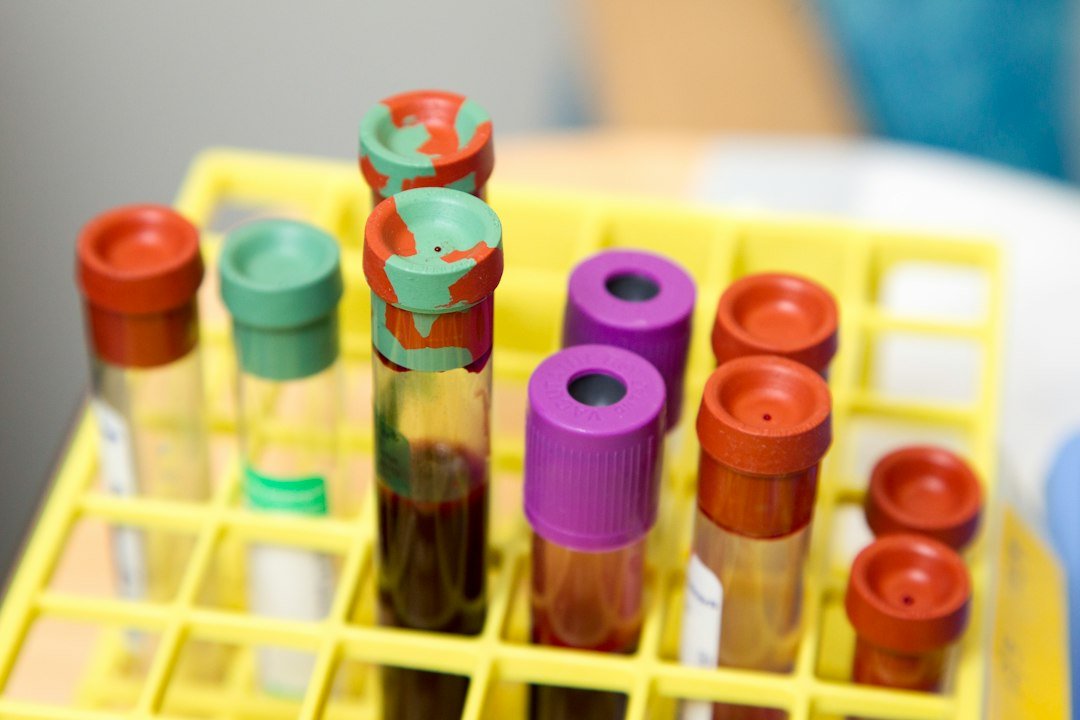
Featured image: Blood-sample tubes illustrate clinical research. Contextual photograph; not PRiSM participant samples, prions or the experimental RNA drug. Photo: National Cancer Institute / Unsplash. Unsplash licence.
A clinical trial of an experimental RNA drug for prion disease has begun enrolling people who have a high-risk genetic variant but no symptoms. The change brings an especially difficult question into early drug development: how to study a possible preventive approach before knowing whether it helps.
The PRiSM investigators announced the new arm on 14 October 2026. A Broad Institute update on 16 October confirms the expansion. Neither announcement reports that the drug prevents disease, slows symptoms or extends human survival.
Lowering a protein rather than rewriting DNA
The candidate, called PrP-siRNA, is designed to reduce production of prion protein, or PrP. In prion disease, abnormally folded forms of this protein can drive further misfolding. The drug’s divalent design joins two small interfering RNA units. The strategy aims to lower the supply of protein involved in the disease process.
As UMass Chan Medical School explains, RNA interference uses short RNA guides and cellular proteins to recognise matching messenger RNA. The target message can then be destroyed or silenced, reducing the instructions available for protein production.
That is different from editing a DNA sequence. A reduction in protein production would also be a different result from demonstrating that a person remains healthy for longer. The mechanism, its measurable biological effect and its eventual clinical value need separate tests.
The Broad report describes delivery into the fluid around the spinal cord through a lumbar puncture. This is not an ordinary injection under the skin, and the early study should not be confused with a finished, routinely available medicine.
The current trial has a narrow job
The ClinicalTrials.gov registration, updated on 16 October, identifies PRiSM as Phase I, with an estimated 45 participants across the study. It uses a single-ascending-dose design: separate groups receive one dose at progressively higher levels, with monitoring between steps.
The registered primary safety outcome tracks adverse events through 24 weeks. Investigators also want to learn whether the candidate lowers PrP and how long any effect lasts. These are early development questions, not a definitive test of prevention.
A trial can therefore be informative even if it cannot answer the question most important to families. Reliable information about dose, duration and harm is needed before a larger study can sensibly test meaningful health outcomes.
A safety gate is not a benefit result
The investigators say the pre-symptomatic arm opened after limited observations at the first dose level in symptomatic participants were considered acceptable by the study’s safety-monitoring board. They explicitly state that human target-engagement results were not yet available.
This decision means the experiment could proceed under its safeguards. It does not establish that the drug is broadly safe or effective. The investigators describe very few treated people, short observation and a limited animal-toxicology package.
The new arm is for people with specified high-risk PRNP genetic variants. It is not a trial of preventive medication for the general public. Its risk–benefit questions differ from those in people already experiencing a rapidly progressive disease.
Prevention needs a longer evidentiary chain
Even a convincing reduction in PrP would leave several questions unresolved. Researchers would still need to establish whether that degree of lowering matters clinically, how sustained treatment behaves and whether any benefit outweighs harm over time.
These are particularly demanding issues for an intervention given before symptoms. People may have healthy years ahead, so a short period without an obvious problem cannot settle the consequences of repeated or long-term treatment.
The useful milestone is the ability to study the candidate in the population relevant to a possible preventive strategy. That expands what researchers can learn; it does not complete the strategy.
PRiSM is now testing whether an RNA-silencing approach can clear its first human hurdles. The result to watch next is credible safety and protein-lowering evidence. Claims about preventing prion disease must wait for a much longer chain of clinical proof.
Reporting and source checks completed on 17 October 2026. By FutureTechDose Editor.
Leave a Reply