
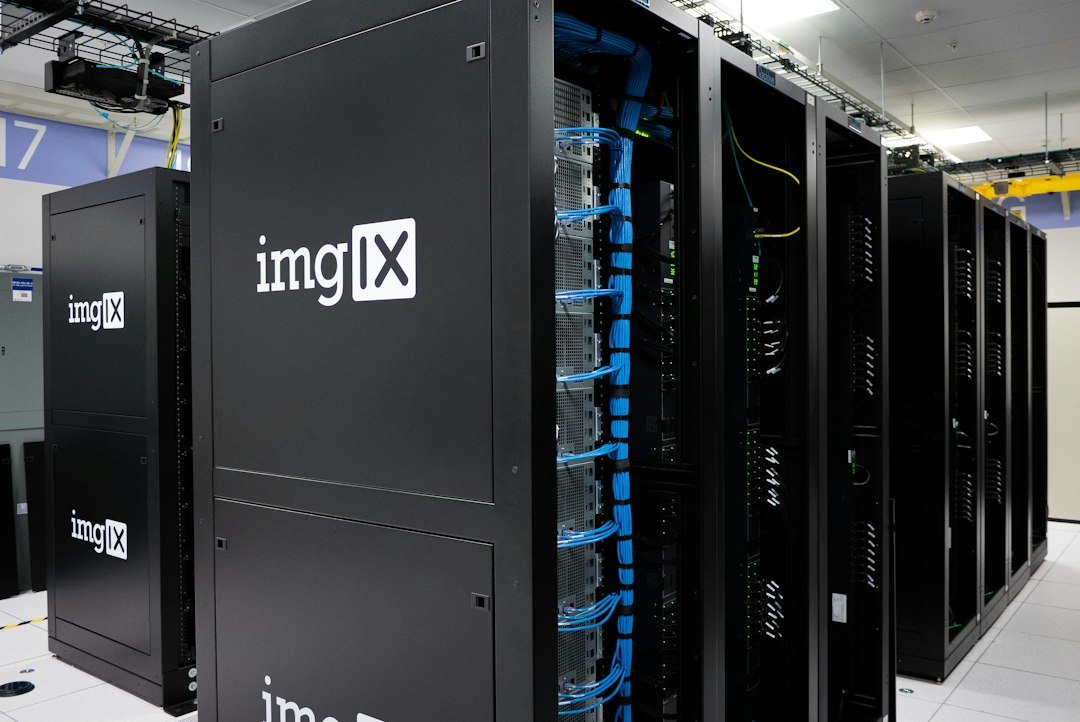
Featured image: Server cabinets illustrate computing infrastructure. Contextual photograph; not the proposed Raystech campus or evidence that its capacity has been built. Photo: imgix / Unsplash. Unsplash licence.
South Australia has another proposal linking renewable-energy development with AI computing. Raystech Group says it is investigating an energy and data-centre campus with an initial phase targeting about 130 megawatts and potential expansion towards 500 MW.
The 16 October 2026 announcement was supplied by Raystech and published in the Smart Energy Council’s member-news section. It describes early-stage plans and continuing discussions. The headline capacity is an ambition to evaluate, rather than electricity already secured for an operating AI facility.
The first phase is smaller than the headline
Raystech says its subsidiary Raystech Utility is progressing the proposal at an industrial site. It identifies nearby water and fibre infrastructure, surrounding renewable resources and possible grid-connection pathways found through preliminary investigations.
The company is exploring collaboration with data-centre operators, designers and technical partners. Expansion beyond the first phase depends on further investigations, grid capacity and other infrastructure and planning requirements. The announcement does not establish a completed connection agreement or a construction start.
Keeping the approximately 130 MW starting target beside the possible 500 MW total is important. A staged proposal can change as engineering and demand become clearer. Treating its largest number as a single committed build would conceal that uncertainty.
The release also does not provide a detailed breakdown separating computing-equipment demand from total facility demand. Until that boundary is specified, the capacity figures should be repeated as the developer’s stated targets rather than converted into a server count.
A promising site still needs a connection process
An industrial site can offer useful ingredients without providing permission to draw hundreds of megawatts. The Australian Energy Market Operator’s connection guidance says a proponent should first engage the connecting network service provider, which manages the process.
AEMO’s role includes assessing technical performance and models, together with commissioning-related work. These are steps for demonstrating how connected equipment will behave as part of a shared power system. They are different from identifying a nearby line on a map.
For this proposal, the evidence to watch would be specific connection milestones and the terms attached to them. Those would help distinguish capacity that is theoretically available from capacity the project can reliably use under an agreed design.
Renewable energy and round-the-clock computing need a joint plan
Raystech presents its renewable supply chain and energy-storage capabilities as a foundation for the campus. That is a development proposition, not a published operating result for the site.
The Australian Government’s data-centre energy guide explains that cooling and other supporting systems contribute to total energy use, and that high demand can make supplying a facility entirely from on-site renewables impractical. A credible design therefore needs to describe the whole facility and its wider supply arrangements.
For readers, the useful distinction is between access to renewable resources and an arrangement that meets computing demand over time. The latter requires clarity about generation, storage, backup, network services and which parts of the workload can be flexible.
Large loads also need to be visible to the system
In its data-centre reform work, AEMO identifies the importance of operational visibility, monitoring, communication and information sharing for large inverter-based loads. That is relevant background to this type of development, rather than a statement that Raystech has met a new technical standard.
The project has also proposed staged community engagement and local employment and training opportunities. Those remain intentions. Detailed plans would make it possible to assess water use, local impacts, construction activity and lasting operational benefits.
The proposal is significant because it combines an energy developer’s capabilities with the scale of demand associated with AI infrastructure. Its next milestones should be concrete: named delivery partners, clearly defined electrical capacity, connection progress and planning documentation.
South Australia may offer an attractive setting for that work. The announcement begins the public account of a project; the engineering and approval record will determine how much of its potential becomes usable infrastructure.
Reporting and source checks completed on 16 October 2026. By FutureTechDose Editor.
Leave a Reply